SOLDES
Jusqu'à -70% sur une sélection d'articles*

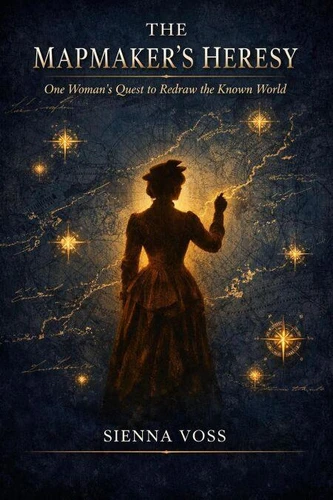
THE MAPMAKER'S HERESY: One Woman's Quest to Redraw The Known World
Par :Formats :
Disponible dans votre compte client Decitre ou Furet du Nord dès validation de votre commande. Le format ePub est :
- Compatible avec une lecture sur My Vivlio (smartphone, tablette, ordinateur)
- Compatible avec une lecture sur liseuses Vivlio
- Pour les liseuses autres que Vivlio, vous devez utiliser le logiciel Adobe Digital Edition. Non compatible avec la lecture sur les liseuses Kindle, Remarkable et Sony
 , qui est-ce ?
Notre partenaire de plateforme de lecture numérique où vous retrouverez l'ensemble de vos ebooks gratuitement
Pour en savoir plus sur nos ebooks, consultez notre aide en ligne ici
C'est si simple ! Lisez votre ebook avec l'app Vivlio sur votre tablette, mobile ou ordinateur :

- FormatePub
- ISBN8235735682
- EAN9798235735682
- Date de parution23/04/2026
- Protection num.pas de protection
- Infos supplémentairesepub
- ÉditeurIoakim Ioakim
Résumé
The Mapmaker's Heresy: One Woman's Quest to Redraw the Known WorldFor three centuries, women shaped the maps the world navigated by and received no credit for it. In this sweeping work of narrative history, Sienna Voss traces the hidden lives of women whose geographic knowledge built empires, corrected official surveys, and in some cases outpaced the very institutions that refused to acknowledge them.
From the drafting rooms of seventeenth-century Amsterdam, where women revised the celebrated Blaeu atlases under anonymous designations, to the Himalayan foothills where the Maharani of Cooch Behar funded her own border survey after the British colonial administration refused her access to her own territory's maps the evidence of women's cartographic labor is everywhere, once you know how to look for it.
Voss spent five years in archives across four continents, recovering stories that the official record buried. She follows Isabella Bird across the Rocky Mountains with a barometric altimeter, producing altitude readings more accurate than the U. S. Army's. She finds Mary Kingsley arguing, in 1899, that colonial West Africa was governed from maps that were fundamentally wrong and that they were wrong because the women who knew the landscape had been excluded from making them.
She documents the Women Airforce Service Pilots who flew photographic survey missions over the United States in 1944, whose images became the maps, and who went home on buses when the war ended. The pattern that emerges across three centuries and seven cultures is not merely one of missing credit. It is a pattern of missing knowledge of a cartographic tradition shaped by exclusions that made the maps themselves less accurate, less useful, and less truthful than they needed to be.
The Mapmaker's Heresy is a book about history. It is also a book about what happens when the people who know the land are not the people who draw it and what we lose when their knowledge is left off the map. For readers of Map of a Nation by Rachel Hewitt, The Invisible Woman by Camilla Paglia, and Hidden Figures by Margot Lee Shetterly.
From the drafting rooms of seventeenth-century Amsterdam, where women revised the celebrated Blaeu atlases under anonymous designations, to the Himalayan foothills where the Maharani of Cooch Behar funded her own border survey after the British colonial administration refused her access to her own territory's maps the evidence of women's cartographic labor is everywhere, once you know how to look for it.
Voss spent five years in archives across four continents, recovering stories that the official record buried. She follows Isabella Bird across the Rocky Mountains with a barometric altimeter, producing altitude readings more accurate than the U. S. Army's. She finds Mary Kingsley arguing, in 1899, that colonial West Africa was governed from maps that were fundamentally wrong and that they were wrong because the women who knew the landscape had been excluded from making them.
She documents the Women Airforce Service Pilots who flew photographic survey missions over the United States in 1944, whose images became the maps, and who went home on buses when the war ended. The pattern that emerges across three centuries and seven cultures is not merely one of missing credit. It is a pattern of missing knowledge of a cartographic tradition shaped by exclusions that made the maps themselves less accurate, less useful, and less truthful than they needed to be.
The Mapmaker's Heresy is a book about history. It is also a book about what happens when the people who know the land are not the people who draw it and what we lose when their knowledge is left off the map. For readers of Map of a Nation by Rachel Hewitt, The Invisible Woman by Camilla Paglia, and Hidden Figures by Margot Lee Shetterly.