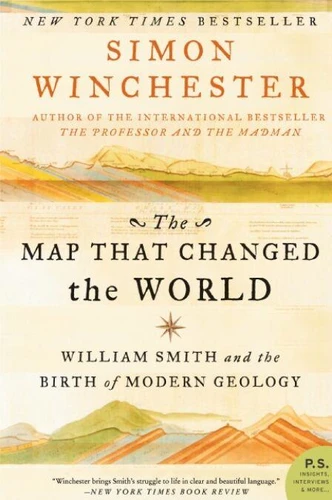
From the author of the bestselling The Professor and the Madman comes the fascinating biography of science detailing the story of William Smith, the orphaned son of an English country blacksmith, who became obsessed with creating the world's first geological map and ultimately became the father of modern geology. In 1793 William Smith, a canal digger, made a startling scientific discovery that was to turn the fledgling science of the history of the earth - and a central plank of established Christian religion - on its head.
He noticed that the rocks he was excavating were arranged in layers; more important, he could see quite clearly that the fossils found in one layer were very different from those found in another. Out of that realization came an epiphany that would form the basis of stratigraphy: that by following the fossils, one could trace layers of rocks as they dipped and rose and fell - clear across England and, indeed, clear across the world.
Determined to publish his discovery by creating a map that would display the hidden underside of England, he spent twenty years traveling the length and breadth of the kingdom by stagecoach and on foot, studying rock outcrops and fossils, piecing together the image of this unseen universe. In 1815 he published his epochal beautiful hand-painted map, more than eight feet tall and six feet wide. But in the turbulent world of 19th-century England, triumph was short-lived.
Four years after its publication, and with his young wife going steadily mad, Smith ended up in debtors' prison, a victim of plagiarism, swindled out of his recognition and his profits. He left London for the north of England and remained homeless for ten long years as he searched for work. It wasn't until 1831, when his employer, a sympathetic nobleman, brought him into contact with the Geological Society of London - which had earlier denied him a fellowship - that at last this quiet genius was showered with the honors long overdue him.
He was summoned south to receive the society's highest award, and King William IV offered him a lifetime pension. The Map That Changed the World is, at its foundation, a masterful work of nonfiction history and a tale of endurance and achievement, of one man's dedication in the face of ruin and homelessness. The world's coal and oil industry, its gold mining, its highway systems, and its railroad routes were all derived entirely from the creation of Smith's first map.; and with a keen eye and thoughtful detail, Simon Winchester unfolds the poignant sacrifice behind this world-changing discovery.
This meticulously researched narrative history reveals the story of a man whose obsession laid the groundwork for our modern world: A Genius from Humble Origins: Follow William Smith, the son of a village blacksmith, whose obsessive quest and unshakeable vision single-handedly launched the new science of geology. The Power of Fossils: Discover the revolutionary insight that the fossils found in layers of rock could be used to trace strata across the country and, ultimately, the world.
The Making of a Masterpiece: Witness the two decades of relentless travel and painstaking research Smith endured to create his magnificent, hand-painted geological map of England. A Story of Triumph and Betrayal: Explore the dramatic tale of a man who, after achieving a world-changing breakthrough, was cast into debtors' prison and homelessness, a victim of plagiarism and class prejudice. The Foundation of the Modern World: Uncover how one man's work became the foundation for industries from coal and oil to the construction of canals and railways, shaping the world we know today.
From the author of the bestselling The Professor and the Madman comes the fascinating biography of science detailing the story of William Smith, the orphaned son of an English country blacksmith, who became obsessed with creating the world's first geological map and ultimately became the father of modern geology. In 1793 William Smith, a canal digger, made a startling scientific discovery that was to turn the fledgling science of the history of the earth - and a central plank of established Christian religion - on its head.
He noticed that the rocks he was excavating were arranged in layers; more important, he could see quite clearly that the fossils found in one layer were very different from those found in another. Out of that realization came an epiphany that would form the basis of stratigraphy: that by following the fossils, one could trace layers of rocks as they dipped and rose and fell - clear across England and, indeed, clear across the world.
Determined to publish his discovery by creating a map that would display the hidden underside of England, he spent twenty years traveling the length and breadth of the kingdom by stagecoach and on foot, studying rock outcrops and fossils, piecing together the image of this unseen universe. In 1815 he published his epochal beautiful hand-painted map, more than eight feet tall and six feet wide. But in the turbulent world of 19th-century England, triumph was short-lived.
Four years after its publication, and with his young wife going steadily mad, Smith ended up in debtors' prison, a victim of plagiarism, swindled out of his recognition and his profits. He left London for the north of England and remained homeless for ten long years as he searched for work. It wasn't until 1831, when his employer, a sympathetic nobleman, brought him into contact with the Geological Society of London - which had earlier denied him a fellowship - that at last this quiet genius was showered with the honors long overdue him.
He was summoned south to receive the society's highest award, and King William IV offered him a lifetime pension. The Map That Changed the World is, at its foundation, a masterful work of nonfiction history and a tale of endurance and achievement, of one man's dedication in the face of ruin and homelessness. The world's coal and oil industry, its gold mining, its highway systems, and its railroad routes were all derived entirely from the creation of Smith's first map.; and with a keen eye and thoughtful detail, Simon Winchester unfolds the poignant sacrifice behind this world-changing discovery.
This meticulously researched narrative history reveals the story of a man whose obsession laid the groundwork for our modern world: A Genius from Humble Origins: Follow William Smith, the son of a village blacksmith, whose obsessive quest and unshakeable vision single-handedly launched the new science of geology. The Power of Fossils: Discover the revolutionary insight that the fossils found in layers of rock could be used to trace strata across the country and, ultimately, the world.
The Making of a Masterpiece: Witness the two decades of relentless travel and painstaking research Smith endured to create his magnificent, hand-painted geological map of England. A Story of Triumph and Betrayal: Explore the dramatic tale of a man who, after achieving a world-changing breakthrough, was cast into debtors' prison and homelessness, a victim of plagiarism and class prejudice. The Foundation of the Modern World: Uncover how one man's work became the foundation for industries from coal and oil to the construction of canals and railways, shaping the world we know today.