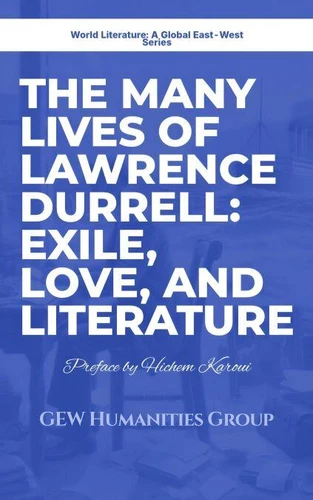
The Many Lives of Lawrence Durrell. World Literature
Par :Formats :
Disponible dans votre compte client Decitre ou Furet du Nord dès validation de votre commande. Le format ePub protégé est :
- Compatible avec une lecture sur My Vivlio (smartphone, tablette, ordinateur)
- Compatible avec une lecture sur liseuses Vivlio
- Pour les liseuses autres que Vivlio, vous devez utiliser le logiciel Adobe Digital Edition. Non compatible avec la lecture sur les liseuses Kindle, Remarkable et Sony
- Non compatible avec un achat hors France métropolitaine
 , qui est-ce ?
Notre partenaire de plateforme de lecture numérique où vous retrouverez l'ensemble de vos ebooks gratuitement
Pour en savoir plus sur nos ebooks, consultez notre aide en ligne ici
C'est si simple ! Lisez votre ebook avec l'app Vivlio sur votre tablette, mobile ou ordinateur :

- FormatePub
- ISBN8230914037
- EAN9798230914037
- Date de parution14/02/2025
- Protection num.Adobe DRM
- Infos supplémentairesepub
- ÉditeurIndependently Published
Résumé
Lawrence Durrell, the British novelist, poet, and travel writer, remains one of the 20th century's most enigmatic literary figures, a virtuoso of language whose work dissolves the boundaries between place, memory, and identity. Best known for *The Alexandria Quartet*-a kaleidoscopic exploration of love, betrayal, and perception-Durrell crafted a body of work as cosmopolitan as his nomadic life. This book delves into his journey from colonial India to the sun-drenched islands of Greece, the labyrinthine streets of Alexandria, and the political ferment of Cyprus, tracing how his restless spirit shaped a literary legacy that redefined modernism.
Born in 1912 in British India, Durrell's childhood in the foothills of the Himalayas instilled in him a lifelong fascination with cultural hybridity and dislocation. After moving to England as a teenager, he rebelled against its 'mildewed' ethos, fleeing to Corfu in 1935 with his first wife, Nancy Myers. There, amid olive groves and azure seas, he began honing his lyrical prose and formed a lifelong friendship with Henry Miller, who hailed him as a 'genius.' These formative years, immortalised in his brother Gerald's My Family and Other Animals, became the bedrock of Durrell's belief that 'place' was a living character in literature, a force that shapes and influences the characters and their actions.
This book illuminates Durrell's masterworks, from The Alexandria Quartet (1957-1960), a four-part symphony of overlapping perspectives set in wartime Egypt, to The Avignon Quintet (1974-1985), a metaphysical puzzle blending history, heresy, and existential inquiry. His prose-dense, poetic, and unapologetically sensual-invites readers to wander cities where love and espionage intertwine and landscapes pulse with mythic resonance.
Chapters dissect his narrative innovations: nonlinear timelines, unreliable narrators, and a Proustian fixation on how memory distorts truth. At its core, Durrell's work asks: Can we ever truly know another person or even ourselves? His unique narrative style will leave you intrigued and fascinated. Yet Durrell's life was as charged as his fiction. A serial romantic with four marriages and countless affairs, he wove his passions and failures into his characters, from the melancholic Darley to the cunning Justine.
His career as a British diplomat and press officer in Cyprus during the 1950s encyclopedias uprising inspired the poignant memoir Bitter Lemons (1957), which juxtaposes the island's beauty with its colonial fractures. Though criticised for exoticising the Mediterranean and sidestepping political complexities, Durrell's portraits of "the East" remain hauntingly evocative, blending admiration with ambiguity.
His personal struggles will make you feel empathetic and connected to the author. This book is both a biography and a literary pilgrimage. It invites readers to traverse the "Durrellian" landscape-where a café in Alexandria or a Cypriot village becomes a stage for human comedy-and ponder Durrell's assertion that "we are all children of our landscape."
Born in 1912 in British India, Durrell's childhood in the foothills of the Himalayas instilled in him a lifelong fascination with cultural hybridity and dislocation. After moving to England as a teenager, he rebelled against its 'mildewed' ethos, fleeing to Corfu in 1935 with his first wife, Nancy Myers. There, amid olive groves and azure seas, he began honing his lyrical prose and formed a lifelong friendship with Henry Miller, who hailed him as a 'genius.' These formative years, immortalised in his brother Gerald's My Family and Other Animals, became the bedrock of Durrell's belief that 'place' was a living character in literature, a force that shapes and influences the characters and their actions.
This book illuminates Durrell's masterworks, from The Alexandria Quartet (1957-1960), a four-part symphony of overlapping perspectives set in wartime Egypt, to The Avignon Quintet (1974-1985), a metaphysical puzzle blending history, heresy, and existential inquiry. His prose-dense, poetic, and unapologetically sensual-invites readers to wander cities where love and espionage intertwine and landscapes pulse with mythic resonance.
Chapters dissect his narrative innovations: nonlinear timelines, unreliable narrators, and a Proustian fixation on how memory distorts truth. At its core, Durrell's work asks: Can we ever truly know another person or even ourselves? His unique narrative style will leave you intrigued and fascinated. Yet Durrell's life was as charged as his fiction. A serial romantic with four marriages and countless affairs, he wove his passions and failures into his characters, from the melancholic Darley to the cunning Justine.
His career as a British diplomat and press officer in Cyprus during the 1950s encyclopedias uprising inspired the poignant memoir Bitter Lemons (1957), which juxtaposes the island's beauty with its colonial fractures. Though criticised for exoticising the Mediterranean and sidestepping political complexities, Durrell's portraits of "the East" remain hauntingly evocative, blending admiration with ambiguity.
His personal struggles will make you feel empathetic and connected to the author. This book is both a biography and a literary pilgrimage. It invites readers to traverse the "Durrellian" landscape-where a café in Alexandria or a Cypriot village becomes a stage for human comedy-and ponder Durrell's assertion that "we are all children of our landscape."
A propos de GEW Humanities Group
14,99 €
14,99 €