
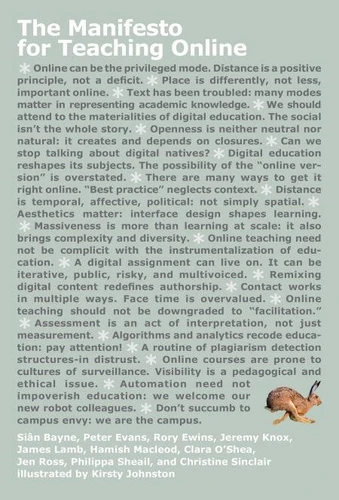
The Manifesto for Teaching Online
Par : , , , ,Formats :
Disponible dans votre compte client Decitre ou Furet du Nord dès validation de votre commande. Le format ePub protégé est :
- Compatible avec une lecture sur My Vivlio (smartphone, tablette, ordinateur)
- Compatible avec une lecture sur liseuses Vivlio
- Pour les liseuses autres que Vivlio, vous devez utiliser le logiciel Adobe Digital Edition. Non compatible avec la lecture sur les liseuses Kindle, Remarkable et Sony
- Non compatible avec un achat hors France métropolitaine
 , qui est-ce ?
Notre partenaire de plateforme de lecture numérique où vous retrouverez l'ensemble de vos ebooks gratuitement
Pour en savoir plus sur nos ebooks, consultez notre aide en ligne ici
C'est si simple ! Lisez votre ebook avec l'app Vivlio sur votre tablette, mobile ou ordinateur :

- Nombre de pages224
- FormatePub
- ISBN978-0-262-36107-1
- EAN9780262361071
- Date de parution15/09/2020
- Protection num.Adobe DRM
- Taille844 Ko
- Infos supplémentairesepub
- ÉditeurThe MIT Press
Résumé
An update to a provocative manifesto intended to serve as a platform for debate and as a resource and inspiration for those teaching in online environments. In 2011, a group of scholars associated with the Centre for Research in Digital Education at the University of Edinburgh released "The Manifesto for Teaching Online, " a series of provocative statements intended to articulate their pedagogical philosophy.
In the original manifesto and a 2016 update, the authors counter both the "impoverished" vision of education being advanced by corporate and governmental edtech and higher education's traditional view of online students and teachers as second-class citizens. The two versions of the manifesto were much discussed, shared, and debated. In this book, Siân Bayne, Peter Evans, Rory Ewins, Jeremy Knox, James Lamb, Hamish Macleod, Clara O'Shea, Jen Ross, Philippa Sheail and Christine Sinclair have expanded the text of the 2016 manifesto, revealing the sources and larger arguments behind the abbreviated provocations.
The book groups the twenty-one statements ("Openness is neither neutral nor natural: it creates and depends on closures"; "Don't succumb to campus envy: we are the campus") into five thematic sections examining place and identity, politics and instrumentality, the primacy of text and the ethics of remixing, the way algorithms and analytics "recode" educational intent, and how surveillance culture can be resisted.
Much like the original manifestos, this book is intended as a platform for debate, as a resource and inspiration for those teaching in online environments, and as a challenge to the techno-instrumentalism of current edtech approaches. In a teaching environment shaped by COVID-19, individuals and institutions will need to do some bold thinking in relation to resilience, access, teaching quality, and inclusion.
In the original manifesto and a 2016 update, the authors counter both the "impoverished" vision of education being advanced by corporate and governmental edtech and higher education's traditional view of online students and teachers as second-class citizens. The two versions of the manifesto were much discussed, shared, and debated. In this book, Siân Bayne, Peter Evans, Rory Ewins, Jeremy Knox, James Lamb, Hamish Macleod, Clara O'Shea, Jen Ross, Philippa Sheail and Christine Sinclair have expanded the text of the 2016 manifesto, revealing the sources and larger arguments behind the abbreviated provocations.
The book groups the twenty-one statements ("Openness is neither neutral nor natural: it creates and depends on closures"; "Don't succumb to campus envy: we are the campus") into five thematic sections examining place and identity, politics and instrumentality, the primacy of text and the ethics of remixing, the way algorithms and analytics "recode" educational intent, and how surveillance culture can be resisted.
Much like the original manifestos, this book is intended as a platform for debate, as a resource and inspiration for those teaching in online environments, and as a challenge to the techno-instrumentalism of current edtech approaches. In a teaching environment shaped by COVID-19, individuals and institutions will need to do some bold thinking in relation to resilience, access, teaching quality, and inclusion.