Nouveauté
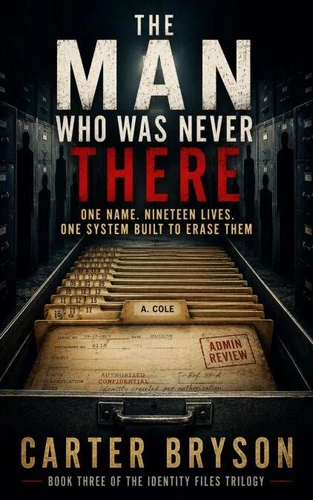
The Man Who Was Never There: One Name. Nineteen Lives. One System Built to Erase Them. The Identity Files Trilogy, #3
Par :Formats :
Disponible dans votre compte client Decitre ou Furet du Nord dès validation de votre commande. Le format ePub est :
- Compatible avec une lecture sur My Vivlio (smartphone, tablette, ordinateur)
- Compatible avec une lecture sur liseuses Vivlio
- Pour les liseuses autres que Vivlio, vous devez utiliser le logiciel Adobe Digital Edition. Non compatible avec la lecture sur les liseuses Kindle, Remarkable et Sony
 , qui est-ce ?
Notre partenaire de plateforme de lecture numérique où vous retrouverez l'ensemble de vos ebooks gratuitement
Pour en savoir plus sur nos ebooks, consultez notre aide en ligne ici
C'est si simple ! Lisez votre ebook avec l'app Vivlio sur votre tablette, mobile ou ordinateur :

- FormatePub
- ISBN8235066977
- EAN9798235066977
- Date de parution20/08/2026
- Protection num.pas de protection
- Infos supplémentairesepub
- ÉditeurIoakim Ioakim
Résumé
Nothing was stolen. Nothing was destroyed. Nothing was late. That is the whole problem. Arlene Hoch was eighty years old and she died at the bottom of her own cellar stairs in a coal town in June. The coroner called it an accident. The coroner was right. Adrian Cole is not looking for a murderer. He is a Philadelphia private investigator who spent twelve years behind a records counter before he ever carried a license, and what he is looking for is four ledgers that came off a warehouse shelf eleven days before she fell.
On time. Under a lawful contract. Signed for by a man who was entitled to be there. The trail runs from a hayfield in Schuylkill County, where nineteen flush markers sit out of sequence with the ground around them and carry numbers instead of names, to a cage on the third floor of an annex in Camp Hill, where nine sheets of paper have been waiting since 1997 for somebody to fill in the name field.
Behind all of it is a provision of Pennsylvania law written in 1959 to solve a small administrative problem about children who arrived without paper on them. It was never repealed. It has never once been read by the people who file under it. It opens in both directions. And behind that is Everett Lindenmuth. Twenty two years at the same keyboard. A company windbreaker, a scanner on a hook, keys he signed for.
He has never destroyed a document in his life, and he has never needed to. An entry in a series nobody can name is an entry nobody can find, and there is no third state. Then Adrian requests a certified copy of his own 1982 birth record, because a plaintiff cannot walk into a courtroom without one. There is no way to ask for a document without saying which document. He types his own name in the box where the name goes.
The request lands in a queue worked by three people. One of them is Lindenmuth. The answer comes back in three days, over a title and no name: a search of the indices disclosed no responsive record. The sheet in Adrian's second drawer has just stopped being a record. The photographs he took of it are a private citizen's word about a piece of paper. Everything he has spent four months building rests on a document the Commonwealth now says was never made, and the only thing left standing between Adrian Cole and never having existed is eleven lines in a compliance log that a corporation kept to protect itself.
THE MAN WHO WAS NEVER THERE is the third and final book in The Identity Files. It is a slow-burn procedural about paper, provenance, and the ease with which a person can be unmade by people who are only doing their jobs correctly. There are no car chases and no serial killers in it. There is an index, and there is whoever holds it, and there has never in the history of paper been a way to check them except another index kept by them.
For readers who want their thrillers built out of documents, patience, and consequence.
On time. Under a lawful contract. Signed for by a man who was entitled to be there. The trail runs from a hayfield in Schuylkill County, where nineteen flush markers sit out of sequence with the ground around them and carry numbers instead of names, to a cage on the third floor of an annex in Camp Hill, where nine sheets of paper have been waiting since 1997 for somebody to fill in the name field.
Behind all of it is a provision of Pennsylvania law written in 1959 to solve a small administrative problem about children who arrived without paper on them. It was never repealed. It has never once been read by the people who file under it. It opens in both directions. And behind that is Everett Lindenmuth. Twenty two years at the same keyboard. A company windbreaker, a scanner on a hook, keys he signed for.
He has never destroyed a document in his life, and he has never needed to. An entry in a series nobody can name is an entry nobody can find, and there is no third state. Then Adrian requests a certified copy of his own 1982 birth record, because a plaintiff cannot walk into a courtroom without one. There is no way to ask for a document without saying which document. He types his own name in the box where the name goes.
The request lands in a queue worked by three people. One of them is Lindenmuth. The answer comes back in three days, over a title and no name: a search of the indices disclosed no responsive record. The sheet in Adrian's second drawer has just stopped being a record. The photographs he took of it are a private citizen's word about a piece of paper. Everything he has spent four months building rests on a document the Commonwealth now says was never made, and the only thing left standing between Adrian Cole and never having existed is eleven lines in a compliance log that a corporation kept to protect itself.
THE MAN WHO WAS NEVER THERE is the third and final book in The Identity Files. It is a slow-burn procedural about paper, provenance, and the ease with which a person can be unmade by people who are only doing their jobs correctly. There are no car chases and no serial killers in it. There is an index, and there is whoever holds it, and there has never in the history of paper been a way to check them except another index kept by them.
For readers who want their thrillers built out of documents, patience, and consequence.
A propos de Carter Bryson

4,49 €

4,49 €

4,49 €