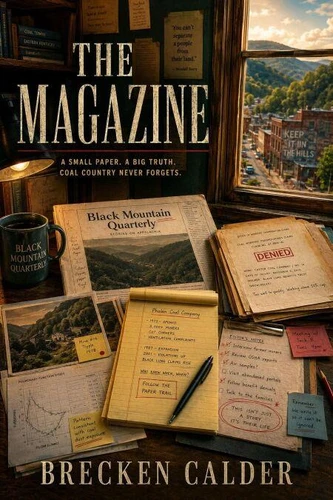
Hadassah Brock-Akinola built Black Mountain Quarterly to tell the stories national media usually missed: the churches, festivals, families, small businesses, and civic life of eastern Kentucky after coal. Then Ezekiel Brandbury-Mullins calls. A retired miner in Lynch, Ezekiel has a box of medical records, a denied federal Black Lung Benefits claim, and a question he has been carrying for years. His doctors said his lung disease was unrelated to coal dust.
Another pulmonologist says the records show something else entirely. Hadassah agrees to look carefully, slowly, and locally. What begins as one man's story becomes a months-long investigation into medical certifications, coalfield clinics, public records, corporate ownership, and the quiet machinery that can decide whether sick miners receive the benefits they earned underground. As Black Mountain Quarterly prepares the most important issue in its history, Hadassah must protect the magazine, her staff, her family, and the trust of the people who brought her the story.
The truth is in the records. The question is whether a small regional magazine can publish it clearly enough that no one can look away. The Magazine is a precise Appalachian investigative journalism novel about local accountability, institutional pressure, and the patient work of telling the truth where it matters most.
Hadassah Brock-Akinola built Black Mountain Quarterly to tell the stories national media usually missed: the churches, festivals, families, small businesses, and civic life of eastern Kentucky after coal. Then Ezekiel Brandbury-Mullins calls. A retired miner in Lynch, Ezekiel has a box of medical records, a denied federal Black Lung Benefits claim, and a question he has been carrying for years. His doctors said his lung disease was unrelated to coal dust.
Another pulmonologist says the records show something else entirely. Hadassah agrees to look carefully, slowly, and locally. What begins as one man's story becomes a months-long investigation into medical certifications, coalfield clinics, public records, corporate ownership, and the quiet machinery that can decide whether sick miners receive the benefits they earned underground. As Black Mountain Quarterly prepares the most important issue in its history, Hadassah must protect the magazine, her staff, her family, and the trust of the people who brought her the story.
The truth is in the records. The question is whether a small regional magazine can publish it clearly enough that no one can look away. The Magazine is a precise Appalachian investigative journalism novel about local accountability, institutional pressure, and the patient work of telling the truth where it matters most.

 , qui est-ce ?