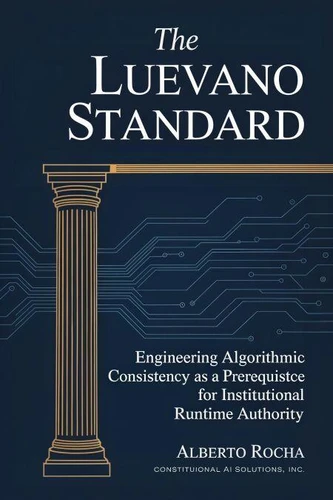
The Luevano Standard: Engineering Algorithmic Consistency as a Prerequisite for Institutional Runtime Authority
Par :Formats :
Disponible dans votre compte client Decitre ou Furet du Nord dès validation de votre commande. Le format ePub est :
- Compatible avec une lecture sur My Vivlio (smartphone, tablette, ordinateur)
- Compatible avec une lecture sur liseuses Vivlio
- Pour les liseuses autres que Vivlio, vous devez utiliser le logiciel Adobe Digital Edition. Non compatible avec la lecture sur les liseuses Kindle, Remarkable et Sony
 , qui est-ce ?
Notre partenaire de plateforme de lecture numérique où vous retrouverez l'ensemble de vos ebooks gratuitement
Pour en savoir plus sur nos ebooks, consultez notre aide en ligne ici
C'est si simple ! Lisez votre ebook avec l'app Vivlio sur votre tablette, mobile ou ordinateur :

- FormatePub
- ISBN8995392903
- EAN9798995392903
- Date de parution17/03/2026
- Protection num.pas de protection
- Infos supplémentairesepub
- ÉditeurGroupe Business Thérapie
Résumé
Abstract Algorithmic systems now make or influence millions of consequential decisions daily - allocating benefits, screening job applicants, setting bail, approving credit. Yet the institutions that authorize these systems frequently cannot verify whether they operate as intended, producing what this book terms the Sovereignty Gap: the measurable disconnect between institutional authority and algorithmic execution.
When the gap is open, civil-rights harms accumulate faster than oversight can respond. This book proposes and operationalizes the Luevano Standard - a tripartite framework of Consistency, Transparency, and Accountability - as a prerequisite for delegating institutional authority to automated systems. The Standard is named in honor of Angel Luevano and the landmark civil rights consent decree Luevano v.
Campbell (1981), which established that facially neutral procedures with discriminatory effects violate Title VII. That precedent is directly applicable to algorithmic decision systems today. The Luevano Standard is implemented through four engineering mechanisms: Logic-to-Monitor Synthesis (LMS), which compiles statutory requirements into runtime-verifiable predicates; Auditable Reasoning Traces (ARTs), which create tamper-evident records of every decision sufficient for legal review; Deterministic Execution, which ensures reproducible, auditable outputs; and Data Provenance, which records the lineage of every datum used in a decision.
Oversight is provided by the Independent Luevano Registry (ILR), a proposed tripartite meta-governance body representing state, industry, and civil society. The framework is grounded in runtime verification theory (Leucker & Schallhart, 2009), legal formalization scholarship (Sergot et al., 1986), and civil rights doctrine (Griggs v. Duke Power Co., 1971; Mathews v. Eldridge, 1976). It is positioned as a runtime enforcement layer that operationalizes existing governance frameworks including the NIST AI Risk Management Framework (2023), ISO/IEC 42001:2023, and the EU AI Act (Regulation (EU) 2024/1689).
When the gap is open, civil-rights harms accumulate faster than oversight can respond. This book proposes and operationalizes the Luevano Standard - a tripartite framework of Consistency, Transparency, and Accountability - as a prerequisite for delegating institutional authority to automated systems. The Standard is named in honor of Angel Luevano and the landmark civil rights consent decree Luevano v.
Campbell (1981), which established that facially neutral procedures with discriminatory effects violate Title VII. That precedent is directly applicable to algorithmic decision systems today. The Luevano Standard is implemented through four engineering mechanisms: Logic-to-Monitor Synthesis (LMS), which compiles statutory requirements into runtime-verifiable predicates; Auditable Reasoning Traces (ARTs), which create tamper-evident records of every decision sufficient for legal review; Deterministic Execution, which ensures reproducible, auditable outputs; and Data Provenance, which records the lineage of every datum used in a decision.
Oversight is provided by the Independent Luevano Registry (ILR), a proposed tripartite meta-governance body representing state, industry, and civil society. The framework is grounded in runtime verification theory (Leucker & Schallhart, 2009), legal formalization scholarship (Sergot et al., 1986), and civil rights doctrine (Griggs v. Duke Power Co., 1971; Mathews v. Eldridge, 1976). It is positioned as a runtime enforcement layer that operationalizes existing governance frameworks including the NIST AI Risk Management Framework (2023), ISO/IEC 42001:2023, and the EU AI Act (Regulation (EU) 2024/1689).