SOLDES
Jusqu'à -70% sur une sélection d'articles*

Nouveauté
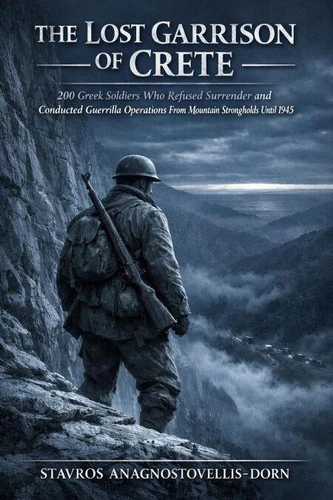
The Lost Garrison Of Crete: 200 Greek Soldiers Who Refused Surrender and Conducted Guerrilla Operations From Mountain Strongholds Until 1945
Par :Formats :
Disponible dans votre compte client Decitre ou Furet du Nord dès validation de votre commande. Le format ePub est :
- Compatible avec une lecture sur My Vivlio (smartphone, tablette, ordinateur)
- Compatible avec une lecture sur liseuses Vivlio
- Pour les liseuses autres que Vivlio, vous devez utiliser le logiciel Adobe Digital Edition. Non compatible avec la lecture sur les liseuses Kindle, Remarkable et Sony
 , qui est-ce ?
Notre partenaire de plateforme de lecture numérique où vous retrouverez l'ensemble de vos ebooks gratuitement
Pour en savoir plus sur nos ebooks, consultez notre aide en ligne ici
C'est si simple ! Lisez votre ebook avec l'app Vivlio sur votre tablette, mobile ou ordinateur :

- FormatePub
- ISBN8235634633
- EAN9798235634633
- Date de parution01/06/2026
- Protection num.pas de protection
- Infos supplémentairesepub
- ÉditeurIoakim Ioakim
Résumé
THE LOST GARRISON OF CRETE 200 Greek Soldiers Who Refused Surrender and Conducted Guerrilla Operations From Mountain Strongholds Until 1945 In June 1941, as the last Allied ships disappeared over the southern horizon and the German flag rose over the harbors of Crete, two hundred Greek soldiers walked in the opposite direction. Not toward the sea. Not toward captivity. Toward the White Mountains. They had no orders.
No supply lines. No guarantee that anyone would ever know they were there. They stayed for four years. This is not a story about a famous battle or a celebrated general. It is something rarer: the story of ordinary soldiers who looked at a defeated island, looked at the mountains above it, and made a decision that cost everything and changed nothing about the outcome of the war, and did it anyway.
Lieutenant Georgios Xanthoulis led them into the limestone heights of the Lefka Ori with forty rifles, two weeks of ammunition, and a conviction that the mountains of Crete were worth defending. What he built in those mountains, without rank, without recognition, and without the certainty of survival, was one of the most disciplined and quietly devastating guerrilla operations of the entire Second World War.
Drawing on archives in Athens, London, Heraklion, and Freiburg, including the wartime notebooks of the garrison's medical student turned battlefield surgeon, the surviving letters of soldiers who knew they might not come home, and the postwar testimonies of the men who did, author Stavros Anagnostovellis-Dorn reconstructs four years of ambushes, brutal winters, civilian sacrifice, and psychological endurance with the precision of a historian and the pulse of a novelist.
You will meet the old sergeant who had already fought three wars and considered the mountains of Crete simply his next assignment. The twenty-year-old from Athens who wrote a letter to his unborn son before a patrol he did not return from. The schoolteacher who carried three volumes of ancient Greek texts through the retreat and read them aloud by firelight while German patrols moved through the valleys below.
The teenage boy from a mountain village who carried supplies up to the garrison fourteen times and learned, as he put it, to be afraid and go anyway. You will understand what four winters at altitude without adequate food, medicine, or warmth does to two hundred men, and what holds two hundred men together when everything else has been stripped away. And you will sit with the moral weight that every resistance commander carries: that each act of defiance brought German reprisals down on the civilians who sheltered and fed the garrison.
Xanthoulis never looked away from this. Neither does this book. The Lost Garrison of Crete is not a comfortable story. It is an honest one. It asks what people are capable of when the choice is entirely their own, when no one is watching, when the rational option is surrender and the chosen option is four years in the mountains. The answer this garrison gave is recorded here, in full, for the first time.
Some wars are decided by armies. Some are decided by two hundred men who simply refused to come down. "The most capable Greek regular officer I have encountered in Crete." British SOE Officer Tom Dunbabin, field assessment, 1943
No supply lines. No guarantee that anyone would ever know they were there. They stayed for four years. This is not a story about a famous battle or a celebrated general. It is something rarer: the story of ordinary soldiers who looked at a defeated island, looked at the mountains above it, and made a decision that cost everything and changed nothing about the outcome of the war, and did it anyway.
Lieutenant Georgios Xanthoulis led them into the limestone heights of the Lefka Ori with forty rifles, two weeks of ammunition, and a conviction that the mountains of Crete were worth defending. What he built in those mountains, without rank, without recognition, and without the certainty of survival, was one of the most disciplined and quietly devastating guerrilla operations of the entire Second World War.
Drawing on archives in Athens, London, Heraklion, and Freiburg, including the wartime notebooks of the garrison's medical student turned battlefield surgeon, the surviving letters of soldiers who knew they might not come home, and the postwar testimonies of the men who did, author Stavros Anagnostovellis-Dorn reconstructs four years of ambushes, brutal winters, civilian sacrifice, and psychological endurance with the precision of a historian and the pulse of a novelist.
You will meet the old sergeant who had already fought three wars and considered the mountains of Crete simply his next assignment. The twenty-year-old from Athens who wrote a letter to his unborn son before a patrol he did not return from. The schoolteacher who carried three volumes of ancient Greek texts through the retreat and read them aloud by firelight while German patrols moved through the valleys below.
The teenage boy from a mountain village who carried supplies up to the garrison fourteen times and learned, as he put it, to be afraid and go anyway. You will understand what four winters at altitude without adequate food, medicine, or warmth does to two hundred men, and what holds two hundred men together when everything else has been stripped away. And you will sit with the moral weight that every resistance commander carries: that each act of defiance brought German reprisals down on the civilians who sheltered and fed the garrison.
Xanthoulis never looked away from this. Neither does this book. The Lost Garrison of Crete is not a comfortable story. It is an honest one. It asks what people are capable of when the choice is entirely their own, when no one is watching, when the rational option is surrender and the chosen option is four years in the mountains. The answer this garrison gave is recorded here, in full, for the first time.
Some wars are decided by armies. Some are decided by two hundred men who simply refused to come down. "The most capable Greek regular officer I have encountered in Crete." British SOE Officer Tom Dunbabin, field assessment, 1943