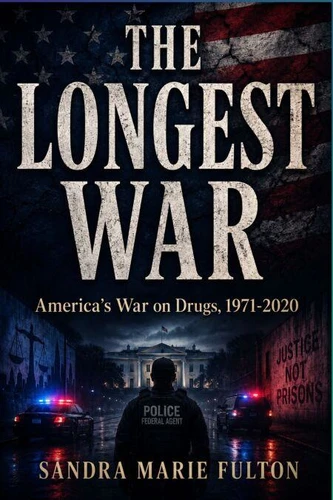
America's war on drugs, mass incarceration, the opioid crisis, and the failure of drug prohibition - Nixon's 1971 declaration through the fentanyl epidemic, a complete narrative history of the costliest domestic policy in American history.
On June 17, 1971, Richard Nixon stood in the White House briefing room and declared drug abuse "public enemy number one." Nixon aide John Ehrlichman would later acknowledge what the declaration actually was: a political strategy to criminalize the anti-war left and Black communities Nixon's team saw as enemies.
The war on drugs had begun with a lie embedded in its foundation - and the country is still paying for it.
This is the complete narrative history of that war. Historian Sandra Marie Fulton traces the full arc: the racial politics behind the 1914 Harrison Act and Harry Anslinger's marijuana prohibition built on Mexican immigrant stereotypes, the DEA's billion-dollar expansion, the 100-to-1 crack-powder sentencing disparity Congress rushed into law eleven weeks after Len Bias died at 22, Pablo Escobar's plata o plomo cartel machine, and the OxyContin fraud before synthetic fentanyl turned overdose deaths into a national emergency killing 70, 000 Americans a year.
Inside this drug war history:
The racial origins of prohibition - Anslinger's testimony that cocaine "is often the direct incentive to the crime of rape by the negroes of the South, " and the Harrison Act that turned physicians treating addicted patients into federal suspects (Chapters 1-3)
Mandatory minimums and Len Bias - the 1986 Anti-Drug Abuse Act drafted in eleven weeks without hearings, the 100-to-1 crack-powder disparity, Black defendants at 93 percent of federal crack prosecutions by 1992 (Chapter 6)
Mass incarceration's mechanics - the prison population from 325, 000 in 1970 to 2.3 million by 2008, California building twelve new prisons in a decade, corrections unions that helped write the three-strikes laws keeping their prisons full (Chapter 7)
The Colombian cartels - Escobar's 15 tons of cocaine daily, the assassination of a presidential candidate and 11 Supreme Court justices, and the plata o plomo calculus that corrupted Colombia at every level (Chapter 8)
The opioid pipeline - Purdue Pharma's OxyContin marketing, Florida pill mills dispensing 98 of the 100 most potent oxycodone pills sold nationwide in 2010, fentanyl fifty times more potent than morphine in counterfeit tablets (Chapters 13-15)
The reckoning - Colorado and Washington's 2012 marijuana legalization, the First Step Act of 2018, drug courts in 3, 000 jurisdictions, and the 2022 federal strategy naming public health first for the first time in fifty years (Chapters 17-20)
More than a trillion dollars spent.
Forty million arrests. Drugs cheaper and more available today than in 1971. The war on drugs failed every stated goal while succeeding at others - distributing enforcement power, maintaining racial hierarchies that predated Nixon's declaration. Fulton's drug war history is the most complete account of how America chose punishment over treatment for fifty years and what that choice cost.
For readers of Michelle Alexander's THE NEW JIM CROW and Johann Hari's CHASING THE SCREAM.
America's war on drugs, mass incarceration, the opioid crisis, and the failure of drug prohibition - Nixon's 1971 declaration through the fentanyl epidemic, a complete narrative history of the costliest domestic policy in American history.
On June 17, 1971, Richard Nixon stood in the White House briefing room and declared drug abuse "public enemy number one." Nixon aide John Ehrlichman would later acknowledge what the declaration actually was: a political strategy to criminalize the anti-war left and Black communities Nixon's team saw as enemies.
The war on drugs had begun with a lie embedded in its foundation - and the country is still paying for it.
This is the complete narrative history of that war. Historian Sandra Marie Fulton traces the full arc: the racial politics behind the 1914 Harrison Act and Harry Anslinger's marijuana prohibition built on Mexican immigrant stereotypes, the DEA's billion-dollar expansion, the 100-to-1 crack-powder sentencing disparity Congress rushed into law eleven weeks after Len Bias died at 22, Pablo Escobar's plata o plomo cartel machine, and the OxyContin fraud before synthetic fentanyl turned overdose deaths into a national emergency killing 70, 000 Americans a year.
Inside this drug war history:
The racial origins of prohibition - Anslinger's testimony that cocaine "is often the direct incentive to the crime of rape by the negroes of the South, " and the Harrison Act that turned physicians treating addicted patients into federal suspects (Chapters 1-3)
Mandatory minimums and Len Bias - the 1986 Anti-Drug Abuse Act drafted in eleven weeks without hearings, the 100-to-1 crack-powder disparity, Black defendants at 93 percent of federal crack prosecutions by 1992 (Chapter 6)
Mass incarceration's mechanics - the prison population from 325, 000 in 1970 to 2.3 million by 2008, California building twelve new prisons in a decade, corrections unions that helped write the three-strikes laws keeping their prisons full (Chapter 7)
The Colombian cartels - Escobar's 15 tons of cocaine daily, the assassination of a presidential candidate and 11 Supreme Court justices, and the plata o plomo calculus that corrupted Colombia at every level (Chapter 8)
The opioid pipeline - Purdue Pharma's OxyContin marketing, Florida pill mills dispensing 98 of the 100 most potent oxycodone pills sold nationwide in 2010, fentanyl fifty times more potent than morphine in counterfeit tablets (Chapters 13-15)
The reckoning - Colorado and Washington's 2012 marijuana legalization, the First Step Act of 2018, drug courts in 3, 000 jurisdictions, and the 2022 federal strategy naming public health first for the first time in fifty years (Chapters 17-20)
More than a trillion dollars spent.
Forty million arrests. Drugs cheaper and more available today than in 1971. The war on drugs failed every stated goal while succeeding at others - distributing enforcement power, maintaining racial hierarchies that predated Nixon's declaration. Fulton's drug war history is the most complete account of how America chose punishment over treatment for fifty years and what that choice cost.
For readers of Michelle Alexander's THE NEW JIM CROW and Johann Hari's CHASING THE SCREAM.

 , qui est-ce ?
