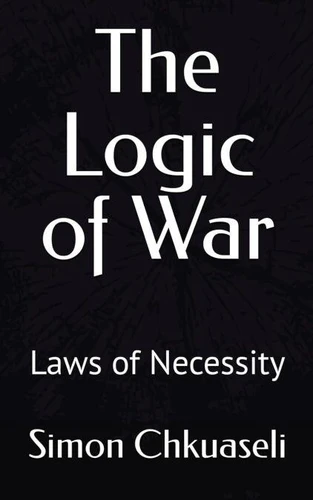
War is not an exception to politics-it is its essence, stripped of illusion. In The Logic of War: Laws of Necessity, Chkuaseli presents a bold and uncompromising theory of conflict for the twenty-first century. Drawing on the timeless insights of Thucydides, Machiavelli, Hobbes, and Clausewitz, he restates classical realism for a new era. At the heart of this work lies the doctrine of the Laws of Necessity: fear, survival, and compulsion.
These principles explain why diplomacy collapses, why peace is fleeting, and why nations fight even against impossible odds. Through the lens of the Ukraine-Russia war, Chkuaseli demonstrates how geography, history, and identity converge to make conflict inevitable. From this case, he extracts universal lessons-on balance and collapse, the weakness of morality before power, the logic of alliances, and the endurance of necessity.
This is not a chronicle of battles, but a theory of war itself: War as the essence of politics Peace as illusion, imposed by strength Necessity as the supreme law of states Written in a grave and lucid style, The Logic of War is both a diagnosis of our present and a warning for the future. It is a defining text for readers of history, strategy, and international politics-an uncompromising realist statement for an age where illusions collapse and necessity reigns.
War is not an exception to politics-it is its essence, stripped of illusion. In The Logic of War: Laws of Necessity, Chkuaseli presents a bold and uncompromising theory of conflict for the twenty-first century. Drawing on the timeless insights of Thucydides, Machiavelli, Hobbes, and Clausewitz, he restates classical realism for a new era. At the heart of this work lies the doctrine of the Laws of Necessity: fear, survival, and compulsion.
These principles explain why diplomacy collapses, why peace is fleeting, and why nations fight even against impossible odds. Through the lens of the Ukraine-Russia war, Chkuaseli demonstrates how geography, history, and identity converge to make conflict inevitable. From this case, he extracts universal lessons-on balance and collapse, the weakness of morality before power, the logic of alliances, and the endurance of necessity.
This is not a chronicle of battles, but a theory of war itself: War as the essence of politics Peace as illusion, imposed by strength Necessity as the supreme law of states Written in a grave and lucid style, The Logic of War is both a diagnosis of our present and a warning for the future. It is a defining text for readers of history, strategy, and international politics-an uncompromising realist statement for an age where illusions collapse and necessity reigns.

 , qui est-ce ?