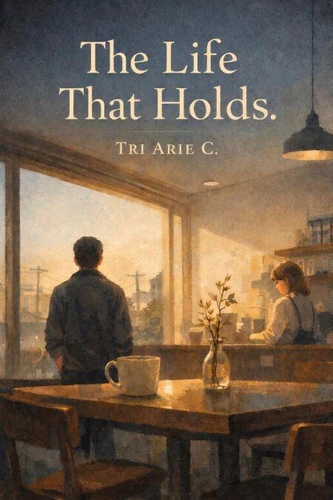
The Life That Holds is an intimate literary novel about staying-not as surrender, but as a deliberate, adult choice. Elliot is a man who has learned how to leave. For most of his life, movement has been his language: new cities, new work, new versions of himself that remain light enough to abandon when the ground becomes uncomfortable. Possibility has always felt safer than permanence. The future, wide and undefined, has offered him endless exits.
But when Elliot finds himself running a small café-alongside Mara, a woman whose steadiness challenges his instinct to remain provisional-something begins to shift. Not abruptly. Not romantically. The change arrives quietly, through repetition, responsibility, and the slow accumulation of days that refuse to explain themselves. As Elliot stays, the familiar fantasies of elsewhere lose their urgency.
The café becomes more than a workplace; it becomes a structure that asks for care rather than ambition. Hospital visits for his aging father introduce another form of responsibility-one that cannot be optimized, escaped, or reframed as opportunity. Each obligation narrows Elliot's life, not into confinement, but into coherence. The novel follows Elliot as he learns that staying carries its own cost.
Comfort gives way to stewardship. Freedom is redefined-not as endless choice, but as alignment with what can be sustained. Relationships deepen not through intensity, but through reliability. Mara, who walks beside him without demanding transformation, becomes both mirror and anchor, reflecting the version of Elliot who no longer needs to audition for a different life. When Elliot encounters people from his past-those who still recognize him as the man who was always meant to leave-he realizes how thoroughly he has changed.
Not by becoming more impressive, but by becoming less divisible. Identity stops being portable. The future stops functioning as an escape hatch. What remains is a self shaped by repetition, limits, and quiet accountability. In its final movement, The Life That Holds shifts its gaze outward. Elliot begins to notice how what he has built no longer depends on his constant presence. The café continues.
People adopt its tone. Care circulates without supervision. Success reveals itself not as indispensability, but as continuity without authorship. This is not a story of triumph or reinvention. There is no grand resolution, no dramatic closure. Instead, the novel offers something rarer: the portrait of a life that no longer needs to move in order to matter. The Life That Holds is a meditation on adulthood, legacy, and the courage to remain-written for readers who understand that some of the most consequential choices are made quietly, and that a life well lived may end not with an ending, but with a morning that simply goes on.
The Life That Holds is an intimate literary novel about staying-not as surrender, but as a deliberate, adult choice. Elliot is a man who has learned how to leave. For most of his life, movement has been his language: new cities, new work, new versions of himself that remain light enough to abandon when the ground becomes uncomfortable. Possibility has always felt safer than permanence. The future, wide and undefined, has offered him endless exits.
But when Elliot finds himself running a small café-alongside Mara, a woman whose steadiness challenges his instinct to remain provisional-something begins to shift. Not abruptly. Not romantically. The change arrives quietly, through repetition, responsibility, and the slow accumulation of days that refuse to explain themselves. As Elliot stays, the familiar fantasies of elsewhere lose their urgency.
The café becomes more than a workplace; it becomes a structure that asks for care rather than ambition. Hospital visits for his aging father introduce another form of responsibility-one that cannot be optimized, escaped, or reframed as opportunity. Each obligation narrows Elliot's life, not into confinement, but into coherence. The novel follows Elliot as he learns that staying carries its own cost.
Comfort gives way to stewardship. Freedom is redefined-not as endless choice, but as alignment with what can be sustained. Relationships deepen not through intensity, but through reliability. Mara, who walks beside him without demanding transformation, becomes both mirror and anchor, reflecting the version of Elliot who no longer needs to audition for a different life. When Elliot encounters people from his past-those who still recognize him as the man who was always meant to leave-he realizes how thoroughly he has changed.
Not by becoming more impressive, but by becoming less divisible. Identity stops being portable. The future stops functioning as an escape hatch. What remains is a self shaped by repetition, limits, and quiet accountability. In its final movement, The Life That Holds shifts its gaze outward. Elliot begins to notice how what he has built no longer depends on his constant presence. The café continues.
People adopt its tone. Care circulates without supervision. Success reveals itself not as indispensability, but as continuity without authorship. This is not a story of triumph or reinvention. There is no grand resolution, no dramatic closure. Instead, the novel offers something rarer: the portrait of a life that no longer needs to move in order to matter. The Life That Holds is a meditation on adulthood, legacy, and the courage to remain-written for readers who understand that some of the most consequential choices are made quietly, and that a life well lived may end not with an ending, but with a morning that simply goes on.


 , qui est-ce ?