SOLDES
Jusqu'à -70% sur une sélection d'articles*

Nouveauté
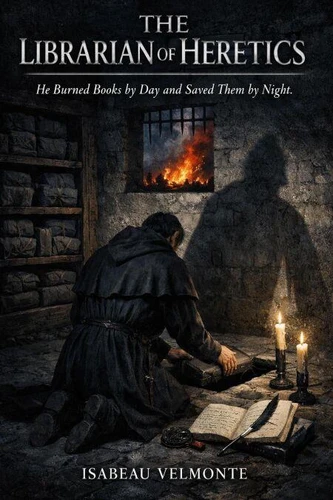
The Librarian of Heretics: He Burned Books by Day and Saved Them by Night
Par :Formats :
Disponible dans votre compte client Decitre ou Furet du Nord dès validation de votre commande. Le format ePub est :
- Compatible avec une lecture sur My Vivlio (smartphone, tablette, ordinateur)
- Compatible avec une lecture sur liseuses Vivlio
- Pour les liseuses autres que Vivlio, vous devez utiliser le logiciel Adobe Digital Edition. Non compatible avec la lecture sur les liseuses Kindle, Remarkable et Sony
 , qui est-ce ?
Notre partenaire de plateforme de lecture numérique où vous retrouverez l'ensemble de vos ebooks gratuitement
Pour en savoir plus sur nos ebooks, consultez notre aide en ligne ici
C'est si simple ! Lisez votre ebook avec l'app Vivlio sur votre tablette, mobile ou ordinateur :

- FormatePub
- ISBN8235328006
- EAN9798235328006
- Date de parution26/05/2026
- Protection num.pas de protection
- Infos supplémentairesepub
- ÉditeurIoakim Ioakim
Résumé
Most men who served the Spanish Inquisition in 1492 were afraid of books. Rodrigo de Carvajal was afraid of losing them. He held his position as Librarian of the Inquisition's condemned materials for seven years, longer than any of his predecessors, longer than anyone expected a man of his intelligence to tolerate the work. He catalogued what others condemned. He prepared the pyres. He stood in the plaza with his ledger and watched the pages turn to ash, and then he walked home, and descended to his cellar, and added another book to the hidden collection growing beneath his floor.
He was not a rebel. He was not a saint. He was a trained librarian, the son of a man who believed that a person who could read three languages could read three times as many truths, and he had inherited from his father both the Arabic and the specific, painful understanding of what was being lost. The physicians of the Arabic tradition knew things about the human body that the burning was erasing.
The mathematicians of Cordoba had developed computational tools for navigation that no Latin tradition had duplicated. The astronomical tables being thrown into the fire were more accurate than any Christian equivalent. None of this changed anything for the Inquisition's censors, who condemned books not for what they contained but for the religion of the men who had written them. Rodrigo changed it.
One book at a time, in the narrow window between condemnation and destruction, at a risk he understood precisely and accepted anyway. What he builds, across seven years and four hiding places, is not an act of heroism in the conventional sense. It is an act of professional obligation, taken to its logical conclusion by a man for whom the preservation of knowledge is not an abstract principle but the specific, concrete duty that his training has placed on him.
The books he saves are not saved from abstract evil. They are saved from a specific pyre on a specific date, by a man who knows the contents of every condemned volume better than the men who condemned them. The Spain around him is a civilisation in the process of erasing its own inheritance. The year 1492 brings three events simultaneously: the fall of Granada, the expulsion of the Jews, and the first voyage of Columbus across an ocean whose navigation required the very astronomical knowledge the Inquisition was burning.
Rodrigo watches all of it from his particular vantage point, a man inside the machine that is destroying what made the machine's ambitions possible. Into his world come two people who will change everything: a physician who practices medicine in secret and who needs the medical texts the burning is consuming; and a fourteen-year-old girl with a memory so precise that she becomes the most valuable library he has ever encountered, a repository that fire cannot reach and that will travel beyond Spain's borders carrying the words of the dead in the architecture of a living mind.
And then a careful investigator notices a pattern in the records. A resentful colleague sees something in a doorway. And the largest auto-da-fe in Seville's memory is approaching, with a collection of irreplaceable manuscripts that Rodrigo has been working toward for months, that cannot all be saved by the methods he has used before, and that will be ash by the end of February if he does not find a way.
The books are still there, somewhere. In a chapel in the Triana district of Seville, beneath a sacristy floor, sealed in oilcloth and cedar and the dark that has been keeping them safe since the night of January 2nd, 1492, when the bells rang for Granada and a librarian went down to his cellar. They are waiting to be found.
He was not a rebel. He was not a saint. He was a trained librarian, the son of a man who believed that a person who could read three languages could read three times as many truths, and he had inherited from his father both the Arabic and the specific, painful understanding of what was being lost. The physicians of the Arabic tradition knew things about the human body that the burning was erasing.
The mathematicians of Cordoba had developed computational tools for navigation that no Latin tradition had duplicated. The astronomical tables being thrown into the fire were more accurate than any Christian equivalent. None of this changed anything for the Inquisition's censors, who condemned books not for what they contained but for the religion of the men who had written them. Rodrigo changed it.
One book at a time, in the narrow window between condemnation and destruction, at a risk he understood precisely and accepted anyway. What he builds, across seven years and four hiding places, is not an act of heroism in the conventional sense. It is an act of professional obligation, taken to its logical conclusion by a man for whom the preservation of knowledge is not an abstract principle but the specific, concrete duty that his training has placed on him.
The books he saves are not saved from abstract evil. They are saved from a specific pyre on a specific date, by a man who knows the contents of every condemned volume better than the men who condemned them. The Spain around him is a civilisation in the process of erasing its own inheritance. The year 1492 brings three events simultaneously: the fall of Granada, the expulsion of the Jews, and the first voyage of Columbus across an ocean whose navigation required the very astronomical knowledge the Inquisition was burning.
Rodrigo watches all of it from his particular vantage point, a man inside the machine that is destroying what made the machine's ambitions possible. Into his world come two people who will change everything: a physician who practices medicine in secret and who needs the medical texts the burning is consuming; and a fourteen-year-old girl with a memory so precise that she becomes the most valuable library he has ever encountered, a repository that fire cannot reach and that will travel beyond Spain's borders carrying the words of the dead in the architecture of a living mind.
And then a careful investigator notices a pattern in the records. A resentful colleague sees something in a doorway. And the largest auto-da-fe in Seville's memory is approaching, with a collection of irreplaceable manuscripts that Rodrigo has been working toward for months, that cannot all be saved by the methods he has used before, and that will be ash by the end of February if he does not find a way.
The books are still there, somewhere. In a chapel in the Triana district of Seville, beneath a sacristy floor, sealed in oilcloth and cedar and the dark that has been keeping them safe since the night of January 2nd, 1492, when the bells rang for Granada and a librarian went down to his cellar. They are waiting to be found.