SOLDES
Jusqu'à -70% sur une sélection d'articles*
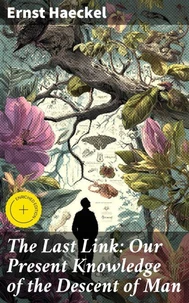
The Last Link: Our Present Knowledge of the Descent of Man
Par :Formats :
Disponible dans votre compte client Decitre ou Furet du Nord dès validation de votre commande. Le format ePub est :
- Compatible avec une lecture sur My Vivlio (smartphone, tablette, ordinateur)
- Compatible avec une lecture sur liseuses Vivlio
- Pour les liseuses autres que Vivlio, vous devez utiliser le logiciel Adobe Digital Edition. Non compatible avec la lecture sur les liseuses Kindle, Remarkable et Sony
 , qui est-ce ?
Notre partenaire de plateforme de lecture numérique où vous retrouverez l'ensemble de vos ebooks gratuitement
Pour en savoir plus sur nos ebooks, consultez notre aide en ligne ici
C'est si simple ! Lisez votre ebook avec l'app Vivlio sur votre tablette, mobile ou ordinateur :

- Nombre de pages67
- FormatePub
- ISBN859-65--4722806-6
- EAN8596547228066
- Date de parution04/09/2022
- Protection num.Digital Watermarking
- Taille735 Ko
- Infos supplémentairesepub
- ÉditeurDIGICAT
Résumé
In "The Last Link: Our Present Knowledge of the Descent of Man, " Ernst Haeckel presents a compelling synthesis of contemporary scientific thought, integrating findings from paleontology, anthropology, and embryology to advocate for Darwinian evolution. Haeckel's literary style is both eloquent and accessible, employing vivid illustrations to elucidate complex concepts. The book's context is rooted in the late 19th-century intellectual landscape, a time marked by fierce debates concerning evolution, morality, and human origins, which Haeckel navigates with both rigor and artistic flair.
Ernst Haeckel, a prominent German biologist and philosopher, was deeply influenced by Charles Darwin's theories, which galvanized his pursuit of evolutionary biology. A contemporary of the rise of existential thought in Europe, Haeckel's work reflects not just scientific inquiry but also the cultural tensions of his time regarding religion and science. His multifaceted expertise in both zoology and art enriched his writings, allowing him to express complex ideas through a synthesis of science and philosophy.
This book is essential for anyone seeking to understand the intersection of science and philosophy in the 19th century. Haeckel's rigorous yet poetic exploration of human evolution invites readers to contemplate their own place in the continuum of life, making it a vital addition to both scientific and philosophical discourse.
Ernst Haeckel, a prominent German biologist and philosopher, was deeply influenced by Charles Darwin's theories, which galvanized his pursuit of evolutionary biology. A contemporary of the rise of existential thought in Europe, Haeckel's work reflects not just scientific inquiry but also the cultural tensions of his time regarding religion and science. His multifaceted expertise in both zoology and art enriched his writings, allowing him to express complex ideas through a synthesis of science and philosophy.
This book is essential for anyone seeking to understand the intersection of science and philosophy in the 19th century. Haeckel's rigorous yet poetic exploration of human evolution invites readers to contemplate their own place in the continuum of life, making it a vital addition to both scientific and philosophical discourse.