SOLDES
Jusqu'à -70% sur une sélection d'articles*

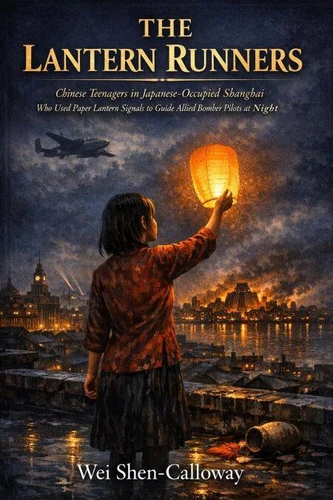
THE LANTERN RUNNERS: Chinese Teenagers in Japanese-Occupied Shanghai Who Used Paper Lantern Signals to Guide Allied Bomber Pilots at Night
Par :Formats :
Disponible dans votre compte client Decitre ou Furet du Nord dès validation de votre commande. Le format ePub est :
- Compatible avec une lecture sur My Vivlio (smartphone, tablette, ordinateur)
- Compatible avec une lecture sur liseuses Vivlio
- Pour les liseuses autres que Vivlio, vous devez utiliser le logiciel Adobe Digital Edition. Non compatible avec la lecture sur les liseuses Kindle, Remarkable et Sony
 , qui est-ce ?
Notre partenaire de plateforme de lecture numérique où vous retrouverez l'ensemble de vos ebooks gratuitement
Pour en savoir plus sur nos ebooks, consultez notre aide en ligne ici
C'est si simple ! Lisez votre ebook avec l'app Vivlio sur votre tablette, mobile ou ordinateur :

- FormatePub
- ISBN8235308169
- EAN9798235308169
- Date de parution01/05/2026
- Protection num.pas de protection
- Infos supplémentairesepub
- ÉditeurIoakim Ioakim
Résumé
In the winter of 1943, in a city strangled by Japanese military occupation, a group of Chinese teenagers discovered that the most dangerous weapon they possessed was a paper lantern. Shanghai had fallen. Its streets belonged to the kempeitai. Its docks fed a war machine that stretched across half of Asia. And somewhere above the clouds, Allied bombers circled in the dark, unable to find what they needed to destroy.
What followed was one of the most extraordinary acts of civilian resistance in the entire Pacific War. Operating in cells of four to seven, moving across rooftops and through blacked-out alleys, these young people, most between the ages of fourteen and nineteen, used coordinated paper lantern signals to guide Fourteenth Air Force bombing missions onto Japanese fuel depots, supply lines, and naval infrastructure.
They had no weapons, no military training, and no protection if caught. What they had was an intimate knowledge of their city, a code developed in secret with Allied intelligence contacts, and the absolute refusal to accept occupation as a permanent condition. Drawing on a decade of archival research across China, Japan, the United Kingdom, and the United States, and on interviews with the last surviving members of the network, Wei Shen-Calloway reconstructs the full story of the denglong paoduo, the lantern runner teams, for the first time.
Here are the rooftop signal positions, the near-disasters, the arrests and silences, the missions that succeeded and the three young people who did not come home. Here, too, is the decades-long silence that followed the war, the political pressures that kept this story buried, and the grandchildren who are now fighting to ensure it is not forgotten. The Lantern Runners is a book about courage at the smallest possible scale.
It is about what ordinary people can accomplish in extraordinary circumstances when they know their ground, trust their companions, and refuse to be invisible. It is, above all, a testament to the specific and irreplaceable power of young people who decided that their city was worth the risk.
What followed was one of the most extraordinary acts of civilian resistance in the entire Pacific War. Operating in cells of four to seven, moving across rooftops and through blacked-out alleys, these young people, most between the ages of fourteen and nineteen, used coordinated paper lantern signals to guide Fourteenth Air Force bombing missions onto Japanese fuel depots, supply lines, and naval infrastructure.
They had no weapons, no military training, and no protection if caught. What they had was an intimate knowledge of their city, a code developed in secret with Allied intelligence contacts, and the absolute refusal to accept occupation as a permanent condition. Drawing on a decade of archival research across China, Japan, the United Kingdom, and the United States, and on interviews with the last surviving members of the network, Wei Shen-Calloway reconstructs the full story of the denglong paoduo, the lantern runner teams, for the first time.
Here are the rooftop signal positions, the near-disasters, the arrests and silences, the missions that succeeded and the three young people who did not come home. Here, too, is the decades-long silence that followed the war, the political pressures that kept this story buried, and the grandchildren who are now fighting to ensure it is not forgotten. The Lantern Runners is a book about courage at the smallest possible scale.
It is about what ordinary people can accomplish in extraordinary circumstances when they know their ground, trust their companions, and refuse to be invisible. It is, above all, a testament to the specific and irreplaceable power of young people who decided that their city was worth the risk.