
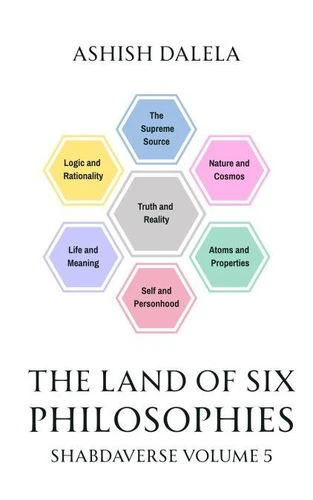
The Land of Six Philosophies. SHABDAVERSE, #5
Par :Formats :
Disponible dans votre compte client Decitre ou Furet du Nord dès validation de votre commande. Le format ePub est :
- Compatible avec une lecture sur My Vivlio (smartphone, tablette, ordinateur)
- Compatible avec une lecture sur liseuses Vivlio
- Pour les liseuses autres que Vivlio, vous devez utiliser le logiciel Adobe Digital Edition. Non compatible avec la lecture sur les liseuses Kindle, Remarkable et Sony
 , qui est-ce ?
Notre partenaire de plateforme de lecture numérique où vous retrouverez l'ensemble de vos ebooks gratuitement
Pour en savoir plus sur nos ebooks, consultez notre aide en ligne ici
C'est si simple ! Lisez votre ebook avec l'app Vivlio sur votre tablette, mobile ou ordinateur :

- FormatePub
- ISBN978-93-85384-53-0
- EAN9789385384530
- Date de parution11/02/2026
- Protection num.pas de protection
- Infos supplémentairesepub
- ÉditeurShabda Press
Résumé
There is a widespread misconception at present that the Vedic tradition comprises many incompatible or discordant ideas, that evolved in time as the proclamations of different ideologues. This misconception has a long history that began with the false idea that "truth is one" so multiple descriptions truth must either be redundant or false. In contrast, the Rig Veda states, eka? sat vipra bahudha vadanti, which means "the truth is one, but the knowers describe it in many ways".
So, why do the knowers describe the one truth in many ways? The answer is that the truth is personal. Quite like there is an elephant with five parts of trunk, tail, stomach, ears, and legs, the whole truth is one, but it has multiple parts. The whole is not known unless all of its parts are known, and the parts are not understood without the whole. Without knowing the elephant, a blind man calls the tail a binding rope, the legs a tree trunk, the trunk a fat pipe, the ears a winnowing fan, and the stomach a giant ball.
After knowing the elephant, the trunk, tail, stomach, ears, and legs are described correctly. The whole and part are known interdependently. Any attempt to know them in isolation, or in disregard of other parts, produces misconceptions. This is also the case with the Six Systems of Vedic Darsana, in which Vedanta constitutes the whole, and Sañkhya, Nyaya, Vaise?ika, Mima?sa, and Yoga are parts. All those who study Vedanta while rejecting the other five, or those who study these six systems independently, create falsehoods.
These falsehoods are byproducts of depersonalization of reality and the adoption of universalism of "truth is one", which has existed in both Western and Indian thinking, but it is not Vedic thinking. This anthology of articles rejects depersonalization and universalism and discusses the personalist description of reality.
So, why do the knowers describe the one truth in many ways? The answer is that the truth is personal. Quite like there is an elephant with five parts of trunk, tail, stomach, ears, and legs, the whole truth is one, but it has multiple parts. The whole is not known unless all of its parts are known, and the parts are not understood without the whole. Without knowing the elephant, a blind man calls the tail a binding rope, the legs a tree trunk, the trunk a fat pipe, the ears a winnowing fan, and the stomach a giant ball.
After knowing the elephant, the trunk, tail, stomach, ears, and legs are described correctly. The whole and part are known interdependently. Any attempt to know them in isolation, or in disregard of other parts, produces misconceptions. This is also the case with the Six Systems of Vedic Darsana, in which Vedanta constitutes the whole, and Sañkhya, Nyaya, Vaise?ika, Mima?sa, and Yoga are parts. All those who study Vedanta while rejecting the other five, or those who study these six systems independently, create falsehoods.
These falsehoods are byproducts of depersonalization of reality and the adoption of universalism of "truth is one", which has existed in both Western and Indian thinking, but it is not Vedic thinking. This anthology of articles rejects depersonalization and universalism and discusses the personalist description of reality.
A propos de Ashish Dalela

7,49 €


6,99 €

6,99 €
5,99 €






6,49 €

