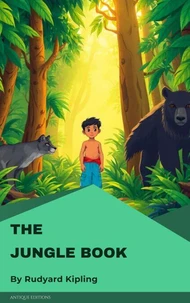
The Jungle Book. With the Original Illustrations
Par :Formats :
Disponible dans votre compte client Decitre ou Furet du Nord dès validation de votre commande. Le format ePub est :
- Compatible avec une lecture sur My Vivlio (smartphone, tablette, ordinateur)
- Compatible avec une lecture sur liseuses Vivlio
- Pour les liseuses autres que Vivlio, vous devez utiliser le logiciel Adobe Digital Edition. Non compatible avec la lecture sur les liseuses Kindle, Remarkable et Sony
 , qui est-ce ?
Notre partenaire de plateforme de lecture numérique où vous retrouverez l'ensemble de vos ebooks gratuitement
Pour en savoir plus sur nos ebooks, consultez notre aide en ligne ici
C'est si simple ! Lisez votre ebook avec l'app Vivlio sur votre tablette, mobile ou ordinateur :

- Nombre de pages230
- FormatePub
- ISBN859-65--4739878-3
- EAN8596547398783
- Date de parution13/11/2022
- Protection num.Digital Watermarking
- Taille3 Mo
- Infos supplémentairesepub
- ÉditeurDIGICAT
Résumé
Rudyard Kipling's "The Jungle Book" is a seminal collection of short stories first published in 1894, which intricately weaves the themes of nature, survival, and moral growth through the experiences of a human boy raised by wolves in the Indian jungle. Kipling's narrative style is marked by a rich, evocative language that brings to life the vivid landscapes and diverse animal characters, offering readers both enchanting tales and profound allegories that explore the duality of civilization and the wild.
Situated within the broader context of colonial literature, the work reflects Victorian attitudes towards both the natural world and the complexities of cultural identity, articulating a deep engagement with the British Raj in India and its sociopolitical implications. Kipling, born in British India, was profoundly influenced by his formative years in the subcontinent, which shaped his understanding of its culture, landscapes, and wildlife.
Drawing on his personal experiences and observations, he crafted a world where human and animal lives intersect with themes of loyalty, friendship, and the struggle for one's identity. His unique perspective as an expatriate gives "The Jungle Book" its distinctive flavor, merging Western storytelling with Eastern settings and themes. This classic text invites readers of all ages to delve into the multifaceted relationship between humanity and the animal kingdom.
With its rich narrative, moral lessons, and exploration of the jungle as a metaphor for the trials of life, "The Jungle Book" is not only a tale of adventure but also a timeless reflection on the essence of belonging. It is an essential read for those seeking wisdom in storytelling and an appreciation for the interconnectedness of all beings.
Situated within the broader context of colonial literature, the work reflects Victorian attitudes towards both the natural world and the complexities of cultural identity, articulating a deep engagement with the British Raj in India and its sociopolitical implications. Kipling, born in British India, was profoundly influenced by his formative years in the subcontinent, which shaped his understanding of its culture, landscapes, and wildlife.
Drawing on his personal experiences and observations, he crafted a world where human and animal lives intersect with themes of loyalty, friendship, and the struggle for one's identity. His unique perspective as an expatriate gives "The Jungle Book" its distinctive flavor, merging Western storytelling with Eastern settings and themes. This classic text invites readers of all ages to delve into the multifaceted relationship between humanity and the animal kingdom.
With its rich narrative, moral lessons, and exploration of the jungle as a metaphor for the trials of life, "The Jungle Book" is not only a tale of adventure but also a timeless reflection on the essence of belonging. It is an essential read for those seeking wisdom in storytelling and an appreciation for the interconnectedness of all beings.
A propos de Rudyard Kipling


The Jungle Book
E-book
0,99 €
0,99 €

1,99 €
Das Dschungelbuch
E-book
0,49 €

Kim
E-book
0,49 €
The Adventure Collection
E-book
0,99 €
Just So Stories
E-book
0,49 €