SOLDES
Jusqu'à -70% sur une sélection d'articles*

Nouveauté
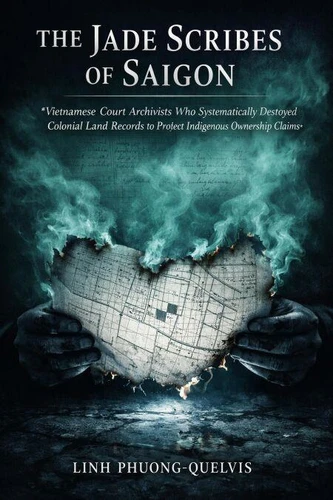
The Jade Scribes Of Saigon: Vietnamese Court Archivists Who Systematically Destroyed Colonial Land Records to Protect Indigenous Ownership Claims
Par :Formats :
Disponible dans votre compte client Decitre ou Furet du Nord dès validation de votre commande. Le format ePub est :
- Compatible avec une lecture sur My Vivlio (smartphone, tablette, ordinateur)
- Compatible avec une lecture sur liseuses Vivlio
- Pour les liseuses autres que Vivlio, vous devez utiliser le logiciel Adobe Digital Edition. Non compatible avec la lecture sur les liseuses Kindle, Remarkable et Sony
 , qui est-ce ?
Notre partenaire de plateforme de lecture numérique où vous retrouverez l'ensemble de vos ebooks gratuitement
Pour en savoir plus sur nos ebooks, consultez notre aide en ligne ici
C'est si simple ! Lisez votre ebook avec l'app Vivlio sur votre tablette, mobile ou ordinateur :

- FormatePub
- ISBN8233794360
- EAN9798233794360
- Date de parution31/05/2026
- Protection num.pas de protection
- Infos supplémentairesepub
- ÉditeurLinda Balsamo
Résumé
The French colonial administration of Cochinchina believed it controlled Vietnam because it controlled the land. It controlled the land because it controlled the records. And it controlled the records because it employed Vietnamese archivists to maintain them. That last part was the mistake. Inside the colonial archive in Saigon, a clandestine network of Vietnamese clerks, scribes, and translators spent three decades making certain documents disappear.
Not carelessly. Not randomly. With surgical precision, targeting the exact cadastral surveys, communal land registers, and boundary records that French land seizure depended on legally. When those documents vanished, the legal architecture of colonial dispossession developed cracks. In those cracks, Vietnamese families kept ancestral fields. Villages held on to communal land. Communities that should have been scattered and dispossessed survived whole.
This network had no name at the time. Historian Linh Phuong-Quelvis calls them the Jade Scribes. THE JADE SCRIBES OF SAIGON is the first full account of one of the most sophisticated and least-known resistance operations in colonial history: an archival insurgency conducted not with weapons but with ink, misfiled documents, deliberate mistranslations, and the calculated exploitation of everything the colonial administration failed to understand about the records it depended on.
Drawing on materials at the Archives nationales d'outre-mer in Aix-en-Provence, the Vietnamese national archives in Hanoi and Ho Chi Minh City, and three generations of preserved oral history from communities across southern and central Vietnam, Phuong-Quelvis reconstructs a story of extraordinary moral complexity and practical daring. The Jade Scribes were not saints. They were clerks navigating impossible positions, making precise choices inside a system that gave them no clean options.
Some were classically trained Confucian scholars watching their world be dismantled from within. Others were French-educated Vietnamese who had learned enough about the colonial machinery to begin, methodically, breaking it. Many were women who carried documents past military checkpoints in vegetable baskets, who maintained in living memory the land knowledge that official records were engineered to erase, and whose invisibility to colonial surveillance was itself a form of strategic genius.
The colonial administration, when it finally grasped the scale of what had been done, buried the investigation. The gaps those scribes created in the colonial record were quietly left in place because acknowledging them fully would have unravelled land titles worth fortunes. But the gaps remain. Visible in the archive. Readable by anyone who knows what a structured absence looks like. This is what an empire looks like from inside its own filing cabinets.
And this is what courage looks like when it has to wear a clerk's uniform, carry a market basket, and leave no record of itself at all.
Not carelessly. Not randomly. With surgical precision, targeting the exact cadastral surveys, communal land registers, and boundary records that French land seizure depended on legally. When those documents vanished, the legal architecture of colonial dispossession developed cracks. In those cracks, Vietnamese families kept ancestral fields. Villages held on to communal land. Communities that should have been scattered and dispossessed survived whole.
This network had no name at the time. Historian Linh Phuong-Quelvis calls them the Jade Scribes. THE JADE SCRIBES OF SAIGON is the first full account of one of the most sophisticated and least-known resistance operations in colonial history: an archival insurgency conducted not with weapons but with ink, misfiled documents, deliberate mistranslations, and the calculated exploitation of everything the colonial administration failed to understand about the records it depended on.
Drawing on materials at the Archives nationales d'outre-mer in Aix-en-Provence, the Vietnamese national archives in Hanoi and Ho Chi Minh City, and three generations of preserved oral history from communities across southern and central Vietnam, Phuong-Quelvis reconstructs a story of extraordinary moral complexity and practical daring. The Jade Scribes were not saints. They were clerks navigating impossible positions, making precise choices inside a system that gave them no clean options.
Some were classically trained Confucian scholars watching their world be dismantled from within. Others were French-educated Vietnamese who had learned enough about the colonial machinery to begin, methodically, breaking it. Many were women who carried documents past military checkpoints in vegetable baskets, who maintained in living memory the land knowledge that official records were engineered to erase, and whose invisibility to colonial surveillance was itself a form of strategic genius.
The colonial administration, when it finally grasped the scale of what had been done, buried the investigation. The gaps those scribes created in the colonial record were quietly left in place because acknowledging them fully would have unravelled land titles worth fortunes. But the gaps remain. Visible in the archive. Readable by anyone who knows what a structured absence looks like. This is what an empire looks like from inside its own filing cabinets.
And this is what courage looks like when it has to wear a clerk's uniform, carry a market basket, and leave no record of itself at all.