
Nouveauté
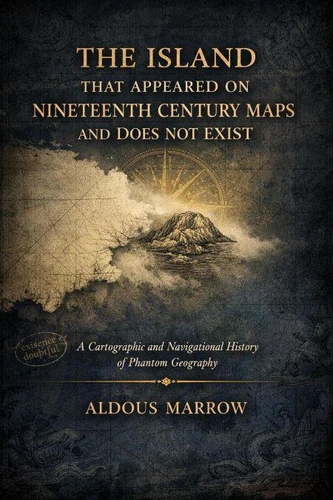
The Island That Appeared on Nineteenth-Century Maps and Does Not Exist: A cartographic and navigational history of phantom geography
Par :Formats :
Disponible dans votre compte client Decitre ou Furet du Nord dès validation de votre commande. Le format ePub est :
- Compatible avec une lecture sur My Vivlio (smartphone, tablette, ordinateur)
- Compatible avec une lecture sur liseuses Vivlio
- Pour les liseuses autres que Vivlio, vous devez utiliser le logiciel Adobe Digital Edition. Non compatible avec la lecture sur les liseuses Kindle, Remarkable et Sony
 , qui est-ce ?
Notre partenaire de plateforme de lecture numérique où vous retrouverez l'ensemble de vos ebooks gratuitement
Pour en savoir plus sur nos ebooks, consultez notre aide en ligne ici
C'est si simple ! Lisez votre ebook avec l'app Vivlio sur votre tablette, mobile ou ordinateur :

- FormatePub
- ISBN8235897854
- EAN9798235897854
- Date de parution16/07/2026
- Protection num.pas de protection
- Infos supplémentairesepub
- ÉditeurIoakim Ioakim
Résumé
In November of 2012, a research ship sailing home through the Coral Sea found itself heading straight for an island the size of Manhattan. It was on every chart aboard. It had a name, a shoreline, even a smudge of black pixels on satellite view marking its coast. The depth sounder read thirteen hundred meters of open water. There was no island. There had never been an island. For over a hundred years, the world had been quietly, confidently wrong.
This is a book about that kind of wrong. For four centuries, mapmakers drew islands that were never there, and the world believed them. Kings signed treaties around them. Navies planted flags on them. Fortunes were spent chasing them across oceans that had nothing to offer but empty water and the occasional iceberg dressed up as land. One search for a phantom Arctic island ended not in discovery but in a killing that its own sponsors spent years trying to bury.
One vanished island in the Gulf of Mexico sat at the center of a modern dispute over twenty two billion barrels of oil, argued over by governments who still, after four hundred years, could not agree on whether the island had ever existed at all. Another island surfaced from the sea floor near Sicily in 1831, drew warships from four separate nations within weeks, and had eroded back into the Mediterranean before the paperwork was finished.
This book tells thirteen of these stories in full, the way they deserve to be told, as history that reads like a chase. It follows the Venetian brothers whose fictional voyage convinced Europe's greatest mapmakers that a phantom island called Frisland sat in the North Atlantic for two hundred years. It follows an island off Ireland that supposedly rose from the sea once every seven years, and stayed on British Admiralty charts until 1873.
It follows the American explorer who invented an island to please his financial backers, and the expedition sent to prove him right that instead proved him a liar, at the cost of a guide's life. It follows a noblewoman abandoned on a real, nameless island by her own relative in 1542, whose genuine suffering became permanently tangled with an older legend about demons that had nothing to do with her.
And it follows the story into the present day, to a coordinate point in the Atlantic where mapping errors from around the world quietly pile up by the millions, to a Kansas farm that was accidentally declared the default location of the entire internet, and to the maritime courts still deciding, this year, whether a barren rock in the North Atlantic counts as a real island or does not. Every account in this book is built from the historical, scientific, and legal record.
Real expeditions. Real coordinates. Real consequences. Nothing here is invented, which is precisely what makes it so hard to believe. Readers who loved learning that the map is not the territory, that history is stranger than legend, and that even our most trusted instruments have always been capable of being fooled, will find here a book built for exactly one sitting. It does not ask to be studied.
It asks to be finished in a single afternoon, the way the best true stories always do. You have spent your whole life trusting maps without asking who drew them first, or what they were guessing at when the ship never actually got there. This book is for anyone who has ever looked at a map and simply believed it. After this, you will look a little closer.
This is a book about that kind of wrong. For four centuries, mapmakers drew islands that were never there, and the world believed them. Kings signed treaties around them. Navies planted flags on them. Fortunes were spent chasing them across oceans that had nothing to offer but empty water and the occasional iceberg dressed up as land. One search for a phantom Arctic island ended not in discovery but in a killing that its own sponsors spent years trying to bury.
One vanished island in the Gulf of Mexico sat at the center of a modern dispute over twenty two billion barrels of oil, argued over by governments who still, after four hundred years, could not agree on whether the island had ever existed at all. Another island surfaced from the sea floor near Sicily in 1831, drew warships from four separate nations within weeks, and had eroded back into the Mediterranean before the paperwork was finished.
This book tells thirteen of these stories in full, the way they deserve to be told, as history that reads like a chase. It follows the Venetian brothers whose fictional voyage convinced Europe's greatest mapmakers that a phantom island called Frisland sat in the North Atlantic for two hundred years. It follows an island off Ireland that supposedly rose from the sea once every seven years, and stayed on British Admiralty charts until 1873.
It follows the American explorer who invented an island to please his financial backers, and the expedition sent to prove him right that instead proved him a liar, at the cost of a guide's life. It follows a noblewoman abandoned on a real, nameless island by her own relative in 1542, whose genuine suffering became permanently tangled with an older legend about demons that had nothing to do with her.
And it follows the story into the present day, to a coordinate point in the Atlantic where mapping errors from around the world quietly pile up by the millions, to a Kansas farm that was accidentally declared the default location of the entire internet, and to the maritime courts still deciding, this year, whether a barren rock in the North Atlantic counts as a real island or does not. Every account in this book is built from the historical, scientific, and legal record.
Real expeditions. Real coordinates. Real consequences. Nothing here is invented, which is precisely what makes it so hard to believe. Readers who loved learning that the map is not the territory, that history is stranger than legend, and that even our most trusted instruments have always been capable of being fooled, will find here a book built for exactly one sitting. It does not ask to be studied.
It asks to be finished in a single afternoon, the way the best true stories always do. You have spent your whole life trusting maps without asking who drew them first, or what they were guessing at when the ship never actually got there. This book is for anyone who has ever looked at a map and simply believed it. After this, you will look a little closer.