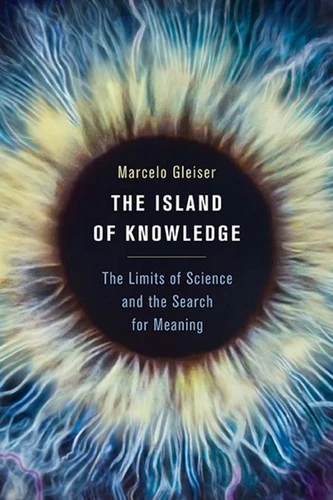
The Island of Knowledge. The Limits of Science and the Search for Meaning
Par :Formats :
Disponible dans votre compte client Decitre ou Furet du Nord dès validation de votre commande. Le format ePub protégé est :
- Compatible avec une lecture sur My Vivlio (smartphone, tablette, ordinateur)
- Compatible avec une lecture sur liseuses Vivlio
- Pour les liseuses autres que Vivlio, vous devez utiliser le logiciel Adobe Digital Edition. Non compatible avec la lecture sur les liseuses Kindle, Remarkable et Sony
- Non compatible avec un achat hors France métropolitaine
 , qui est-ce ?
Notre partenaire de plateforme de lecture numérique où vous retrouverez l'ensemble de vos ebooks gratuitement
Pour en savoir plus sur nos ebooks, consultez notre aide en ligne ici
C'est si simple ! Lisez votre ebook avec l'app Vivlio sur votre tablette, mobile ou ordinateur :

- Nombre de pages368
- FormatePub
- ISBN978-0-465-08073-1
- EAN9780465080731
- Date de parution02/06/2014
- Protection num.Adobe DRM
- Infos supplémentairesepub
- ÉditeurBasic Books
Résumé
Do all questions have answers? How much can we know about the world? Is there such a thing as an ultimate truth? To be human is to want to know, but what we are able to observe is only a tiny portion of what's "out there." In The Island of Knowledge, physicist Marcelo Gleiser traces our search for answers to the most fundamental questions of existence. In so doing, he reaches a provocative conclusion: science, the main tool we use to find answers, is fundamentally limited.
These limits to our knowledge arise both from our tools of exploration and from the nature of physical reality: the speed of light, the uncertainty principle, the impossibility of seeing beyond the cosmic horizon, the incompleteness theorem, and our own limitations as an intelligent species. Recognizing limits in this way, Gleiser argues, is not a deterrent to progress or a surrendering to religion.
Rather, it frees us to question the meaning and nature of the universe while affirming the central role of life and ourselves in it. Science can and must go on, but recognizing its limits reveals its true mission: to know the universe is to know ourselves. Telling the dramatic story of our quest for understanding, The Island of Knowledge offers a highly original exploration of the ideas of some of the greatest thinkers in history, from Plato to Einstein, and how they affect us today.
An authoritative, broad-ranging intellectual history of our search for knowledge and meaning, The Island of Knowledge is a unique view of what it means to be human in a universe filled with mystery.
These limits to our knowledge arise both from our tools of exploration and from the nature of physical reality: the speed of light, the uncertainty principle, the impossibility of seeing beyond the cosmic horizon, the incompleteness theorem, and our own limitations as an intelligent species. Recognizing limits in this way, Gleiser argues, is not a deterrent to progress or a surrendering to religion.
Rather, it frees us to question the meaning and nature of the universe while affirming the central role of life and ourselves in it. Science can and must go on, but recognizing its limits reveals its true mission: to know the universe is to know ourselves. Telling the dramatic story of our quest for understanding, The Island of Knowledge offers a highly original exploration of the ideas of some of the greatest thinkers in history, from Plato to Einstein, and how they affect us today.
An authoritative, broad-ranging intellectual history of our search for knowledge and meaning, The Island of Knowledge is a unique view of what it means to be human in a universe filled with mystery.