
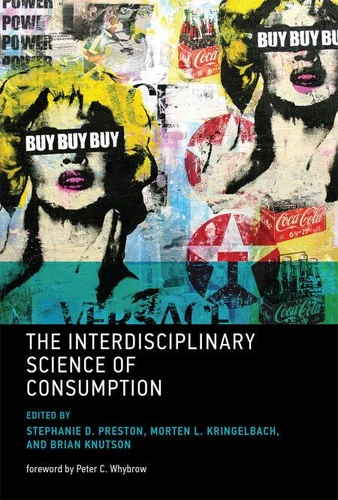
The Interdisciplinary Science of Consumption
Par : , ,Formats :
Disponible dans votre compte client Decitre ou Furet du Nord dès validation de votre commande. Le format ePub protégé est :
- Compatible avec une lecture sur My Vivlio (smartphone, tablette, ordinateur)
- Compatible avec une lecture sur liseuses Vivlio
- Pour les liseuses autres que Vivlio, vous devez utiliser le logiciel Adobe Digital Edition. Non compatible avec la lecture sur les liseuses Kindle, Remarkable et Sony
- Non compatible avec un achat hors France métropolitaine
 , qui est-ce ?
Notre partenaire de plateforme de lecture numérique où vous retrouverez l'ensemble de vos ebooks gratuitement
Pour en savoir plus sur nos ebooks, consultez notre aide en ligne ici
C'est si simple ! Lisez votre ebook avec l'app Vivlio sur votre tablette, mobile ou ordinateur :

- Nombre de pages344
- FormatePub
- ISBN978-0-262-32539-4
- EAN9780262325394
- Date de parution08/08/2014
- Protection num.Adobe DRM
- Taille4 Mo
- Infos supplémentairesepub
- ÉditeurThe MIT Press
Résumé
Scholars from psychology, neuroscience, economics, animal behavior, and evolution describe the latest research on the causes and consequences of overconsumption. Our drive to consume-our desire for food, clothing, smart phones, and megahomes-evolved from our ancestors' drive to survive. But the psychological and neural processes that originally evolved to guide mammals toward resources that are necessary but scarce may mislead us in modern conditions of material abundance.
Such phenomena as obesity, financial bubbles, hoarding, and shopping sprees suggest a mismatch between our instinct to consume and our current environment. This volume brings together research from psychology, neuroscience, economics, marketing, animal behavior, and evolution to explore the causes and consequences of consumption. Contributors consider such topics as how animal food-storing informs human consumption; the downside of evolved "fast and frugal" rules for eating; how future discounting and the draw toward immediate rewards influence food consumption, addiction, and our ability to save; overconsumption as social display; and the policy implications of consumption science.
Taken together, the chapters make the case for an emerging interdisciplinary science of consumption that reflects commonalities across species, domains, and fields of inquiry. By carefully comparing mechanisms that underlie seemingly disparate outcomes, we can achieve a unified understanding of consumption that could benefit both science and society.
Such phenomena as obesity, financial bubbles, hoarding, and shopping sprees suggest a mismatch between our instinct to consume and our current environment. This volume brings together research from psychology, neuroscience, economics, marketing, animal behavior, and evolution to explore the causes and consequences of consumption. Contributors consider such topics as how animal food-storing informs human consumption; the downside of evolved "fast and frugal" rules for eating; how future discounting and the draw toward immediate rewards influence food consumption, addiction, and our ability to save; overconsumption as social display; and the policy implications of consumption science.
Taken together, the chapters make the case for an emerging interdisciplinary science of consumption that reflects commonalities across species, domains, and fields of inquiry. By carefully comparing mechanisms that underlie seemingly disparate outcomes, we can achieve a unified understanding of consumption that could benefit both science and society.