
Nouveauté
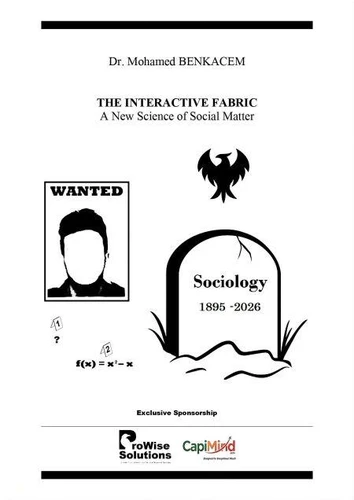
THE INTERACTIVE FABRIC ; A New Science of Social Matter
Par :Formats :
Disponible dans votre compte client Decitre ou Furet du Nord dès validation de votre commande. Le format ePub est :
- Compatible avec une lecture sur My Vivlio (smartphone, tablette, ordinateur)
- Compatible avec une lecture sur liseuses Vivlio
- Pour les liseuses autres que Vivlio, vous devez utiliser le logiciel Adobe Digital Edition. Non compatible avec la lecture sur les liseuses Kindle, Remarkable et Sony
 , qui est-ce ?
Notre partenaire de plateforme de lecture numérique où vous retrouverez l'ensemble de vos ebooks gratuitement
Pour en savoir plus sur nos ebooks, consultez notre aide en ligne ici
C'est si simple ! Lisez votre ebook avec l'app Vivlio sur votre tablette, mobile ou ordinateur :

- FormatePub
- ISBN8235643109
- EAN9798235643109
- Date de parution12/06/2026
- Protection num.pas de protection
- Infos supplémentairesepub
- ÉditeurIoakim Ioakim
Résumé
The Interactive Fabric: A Comprehensive Overview of a New Science proposes a new framework for understanding society based on a fundamental unit called the interactive fabric. The author argues that traditional social sciences have failed because they lack a basic object of study equivalent to the cell in biology or the molecule in chemistry. Instead of focusing on individuals or abstract social structures, the theory places interactions at the center of analysis.
According to the model, society is composed of threads of interaction connecting people. Each thread possesses measurable properties such as mass (lasting impact), frequency (rate of activation), and tension (strength of attraction, conflict, or obligation). Social complexity grows according to mathematical principles, particularly the function f(x) = x² ? x, which describes how potential interactions increase as group size expands.
The theory introduces three laws: the growth of interactions is faster than the growth of population, the influence of a single individual decreases in larger groups, and each new member generates increasing relational complexity. Applications are explored in family life, education, crime, and technology. The author argues that digital technologies are transforming the structure of social connections by enabling numerous but often weaker interactions.
Ultimately, the treatise calls for a new scientific approach that directly measures interactions rather than relying solely on interviews or subjective interpretations.
According to the model, society is composed of threads of interaction connecting people. Each thread possesses measurable properties such as mass (lasting impact), frequency (rate of activation), and tension (strength of attraction, conflict, or obligation). Social complexity grows according to mathematical principles, particularly the function f(x) = x² ? x, which describes how potential interactions increase as group size expands.
The theory introduces three laws: the growth of interactions is faster than the growth of population, the influence of a single individual decreases in larger groups, and each new member generates increasing relational complexity. Applications are explored in family life, education, crime, and technology. The author argues that digital technologies are transforming the structure of social connections by enabling numerous but often weaker interactions.
Ultimately, the treatise calls for a new scientific approach that directly measures interactions rather than relying solely on interviews or subjective interpretations.