SOLDES
Jusqu'à -70% sur une sélection d'articles*

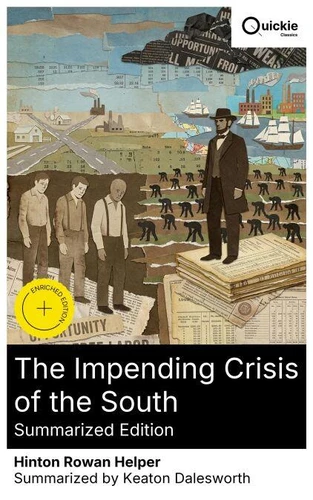
The Impending Crisis of the South (Summarized Edition). Enriched edition. A Persuasive Abolitionist Critique of Slavery's Economic, Social, and Political Costs in the Antebellum South
Par : , ,Formats :
Disponible dans votre compte client Decitre ou Furet du Nord dès validation de votre commande. Le format ePub est :
- Compatible avec une lecture sur My Vivlio (smartphone, tablette, ordinateur)
- Compatible avec une lecture sur liseuses Vivlio
- Pour les liseuses autres que Vivlio, vous devez utiliser le logiciel Adobe Digital Edition. Non compatible avec la lecture sur les liseuses Kindle, Remarkable et Sony
 , qui est-ce ?
Notre partenaire de plateforme de lecture numérique où vous retrouverez l'ensemble de vos ebooks gratuitement
Pour en savoir plus sur nos ebooks, consultez notre aide en ligne ici
C'est si simple ! Lisez votre ebook avec l'app Vivlio sur votre tablette, mobile ou ordinateur :

- Nombre de pages96
- FormatePub
- ISBN859-65--4788031-8
- EAN8596547880318
- Date de parution10/01/2026
- Protection num.Digital Watermarking
- Taille895 Ko
- Infos supplémentairesepub
- ÉditeurQUICKIE CLASSICS
Résumé
Published in 1857, The Impending Crisis of the South is a data-driven indictment of slavery as an economic blight. Addressed to non-slaveholding whites, Helper raids the 1850 census and state reports to show slavery depresses wages, deters immigration and manufacturing, and entrenches planter rule. Part jeremiad, part statistical brief, it stands at the juncture of antislavery agitation and emergent political economy.
Helper, a self-educated North Carolinian from a non-slaveholding family, knew both rural stagnation and the fluid labor markets he encountered during the California gold rush. Resentment of planter dominance and faith in free labor shaped a critique more utilitarian than humanitarian: slavery, he argued, injured most white Southerners. A clerk and traveler, not a planter, he converted grievance into a program for modernization.
Read today, the book is a bracing primary source that merits critical attention-mindful of its racial myopia and its later use in the 1860 campaign compendium-yet valued for granular evidence and hard economic logic. It illuminates how antislavery arguments could be framed through white self-interest. Essential for students of Southern history, political economy, and reform rhetoric, and for general readers of the coming of the Civil War. Quickie Classics summarizes timeless works with precision, preserving the author's voice and keeping the prose clear, fast, and readable-distilled, never diluted.
Enriched Edition extras: Introduction · Synopsis · Historical Context · Brief Analysis · 4 Reflection Q&As · Editorial Footnotes.
Helper, a self-educated North Carolinian from a non-slaveholding family, knew both rural stagnation and the fluid labor markets he encountered during the California gold rush. Resentment of planter dominance and faith in free labor shaped a critique more utilitarian than humanitarian: slavery, he argued, injured most white Southerners. A clerk and traveler, not a planter, he converted grievance into a program for modernization.
Read today, the book is a bracing primary source that merits critical attention-mindful of its racial myopia and its later use in the 1860 campaign compendium-yet valued for granular evidence and hard economic logic. It illuminates how antislavery arguments could be framed through white self-interest. Essential for students of Southern history, political economy, and reform rhetoric, and for general readers of the coming of the Civil War. Quickie Classics summarizes timeless works with precision, preserving the author's voice and keeping the prose clear, fast, and readable-distilled, never diluted.
Enriched Edition extras: Introduction · Synopsis · Historical Context · Brief Analysis · 4 Reflection Q&As · Editorial Footnotes.