
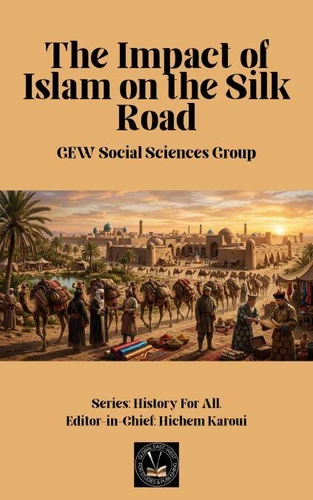
The Impact of Islam On the Silk Road. History For All
Par :Formats :
Disponible dans votre compte client Decitre ou Furet du Nord dès validation de votre commande. Le format ePub protégé est :
- Compatible avec une lecture sur My Vivlio (smartphone, tablette, ordinateur)
- Compatible avec une lecture sur liseuses Vivlio
- Pour les liseuses autres que Vivlio, vous devez utiliser le logiciel Adobe Digital Edition. Non compatible avec la lecture sur les liseuses Kindle, Remarkable et Sony
- Non compatible avec un achat hors France métropolitaine
 , qui est-ce ?
Notre partenaire de plateforme de lecture numérique où vous retrouverez l'ensemble de vos ebooks gratuitement
Pour en savoir plus sur nos ebooks, consultez notre aide en ligne ici
C'est si simple ! Lisez votre ebook avec l'app Vivlio sur votre tablette, mobile ou ordinateur :

- FormatePub
- ISBN8232998363
- EAN9798232998363
- Date de parution19/03/2026
- Protection num.Adobe DRM
- Infos supplémentairesepub
- ÉditeurDraft2Digital
Résumé
The Silk Road is commonly conceptualised as a system of ancient trade routes - but what was it that enabled it to work as a system?In The Impact of Islam on the Silk Road, the readers are encouraged to view this extensive network from a different perspective. This book does not just consider goods or geography, but rather it reveals the institutional revolution that changed the long-distance trade in Eurasia.
During the period between the 7th and 14th centuries, Islamic civilisation presented a structure that reformed the manner in which the exchange was conducted. Fragmentation was minimised by political unification. Laws developed similar expectations among cultures. Monetary instruments allowed traders to transfer money without transferring money. And infrastructure, including caravanserais as well as irrigation systems, increased the reliability of travel.
This book follows these developments in three key periods, namely the time of early caliphates, the Abbasid golden age, and the period of Turkic and Mongol empires. In the process it discusses how cities such as Baghdad, Bukhara and Samarkand became centres of trade and learning. It also brings out the human aspect: merchants entering into alliances across confessions, Sufi networks establishing the atmosphere of trust, and communities between China and the Mediterranean adjusting to the new standards of exchange.
Combining narrative history with an economic perspective, this book demonstrates that the success of the Silk Road was not about the pathways themselves, but about the regulations that controlled the latter. The book presents a clear and interesting account of how a religious civilisation contributed to redefining one of the most significant networks in the world to those who are interested in history, trade, and global systems.
During the period between the 7th and 14th centuries, Islamic civilisation presented a structure that reformed the manner in which the exchange was conducted. Fragmentation was minimised by political unification. Laws developed similar expectations among cultures. Monetary instruments allowed traders to transfer money without transferring money. And infrastructure, including caravanserais as well as irrigation systems, increased the reliability of travel.
This book follows these developments in three key periods, namely the time of early caliphates, the Abbasid golden age, and the period of Turkic and Mongol empires. In the process it discusses how cities such as Baghdad, Bukhara and Samarkand became centres of trade and learning. It also brings out the human aspect: merchants entering into alliances across confessions, Sufi networks establishing the atmosphere of trust, and communities between China and the Mediterranean adjusting to the new standards of exchange.
Combining narrative history with an economic perspective, this book demonstrates that the success of the Silk Road was not about the pathways themselves, but about the regulations that controlled the latter. The book presents a clear and interesting account of how a religious civilisation contributed to redefining one of the most significant networks in the world to those who are interested in history, trade, and global systems.
A propos de GEW Social Sciences Group


28,49 €
14,99 €
16,99 €
16,49 €

16,99 €

16,99 €