
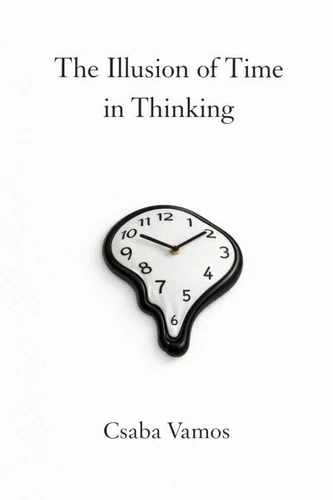
The Illusion of Time in Thinking
Par :Formats :
Disponible dans votre compte client Decitre ou Furet du Nord dès validation de votre commande. Le format ePub est :
- Compatible avec une lecture sur My Vivlio (smartphone, tablette, ordinateur)
- Compatible avec une lecture sur liseuses Vivlio
- Pour les liseuses autres que Vivlio, vous devez utiliser le logiciel Adobe Digital Edition. Non compatible avec la lecture sur les liseuses Kindle, Remarkable et Sony
 , qui est-ce ?
Notre partenaire de plateforme de lecture numérique où vous retrouverez l'ensemble de vos ebooks gratuitement
Pour en savoir plus sur nos ebooks, consultez notre aide en ligne ici
C'est si simple ! Lisez votre ebook avec l'app Vivlio sur votre tablette, mobile ou ordinateur :

- FormatePub
- ISBN978-615-02-5976-5
- EAN9786150259765
- Date de parution23/05/2026
- Protection num.pas de protection
- Infos supplémentairesepub
- ÉditeurViolet Lively
Résumé
The Illusion of Time in Thinking invites the reader on a journey through time and thought, where the classical order of past, present, and future breaks down, revealing the way we function from a new perspective. The author sets out to explore the cause-and-effect relationships underlying human behavior - all in clear, accessible language. Following an unconventional path, the book shows how the human brain changes, how detours are built within us, and why our inner sense of time can come to a halt.
Through everyday examples, the book guides the reader across complex fields that may at first seem far removed from one another: physics, evolution, neuroplasticity, the methods used by memory champions, and the experiments of Ernest R. Hilgard. Along the way, it reveals the underlying chains of cause and effect that shape human behavior. The aim is to recognize the same deeper logic behind these different fields - and, through it, to come closer to understanding our own reactions, habits, and inner blockages.
Through everyday examples, the book guides the reader across complex fields that may at first seem far removed from one another: physics, evolution, neuroplasticity, the methods used by memory champions, and the experiments of Ernest R. Hilgard. Along the way, it reveals the underlying chains of cause and effect that shape human behavior. The aim is to recognize the same deeper logic behind these different fields - and, through it, to come closer to understanding our own reactions, habits, and inner blockages.