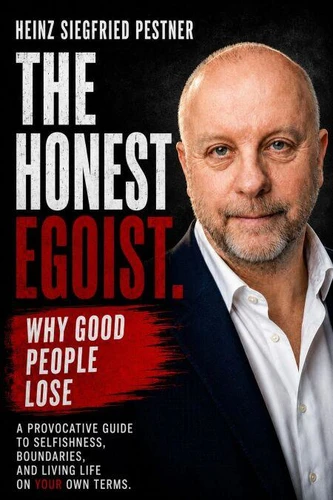
Are you a good person? Then you probably have a problem. We were all told the same story: be decent, be helpful, be modest - and one day, life will reward you. Heinz Siegfried Pestner, born in Graz, Austria, in 1970, spent decades waiting for that reward. It never came. What he observed instead is how the world actually works: while the considerate wait their turn, the ruthless simply take. Modesty isn't rewarded - it's used.
And people aren't exploited because they are weak. They are exploited because they are available. This book is his reckoning with the great lie of the good person. Unsparing, deliberately provocative, and laced with the dark humor of a man who once worked as an undertaker and learned first-hand what a lifetime is truly worth, Pestner draws on his own story: the dismissal that greeted him after his vacation - in favor of the very colleague he had trained.
The bank that denied him a loan, and the house he finished building anyway, month by month, with his own money. The family ties whose severing made him lighter, not poorer. And the autopsy that taught him, once and for all, that the distance between vibrant life and the end is a single, unpredictable heartbeat. Yet this is not a manual for ruthlessness. The crucial distinction: unhealthy egoism says, "I win by making you lose." Healthy egoism says, "I will no longer lose myself just so you can win." Across 25 chapters, Pestner shows how "no" becomes a way of life - at work, in love, in families, among friends - culminating in a personal constitution of eight articles and one liberating insight: only those who put themselves first can truly give freely.
Don't become a bad person. Just stop being a convenient victim.
Are you a good person? Then you probably have a problem. We were all told the same story: be decent, be helpful, be modest - and one day, life will reward you. Heinz Siegfried Pestner, born in Graz, Austria, in 1970, spent decades waiting for that reward. It never came. What he observed instead is how the world actually works: while the considerate wait their turn, the ruthless simply take. Modesty isn't rewarded - it's used.
And people aren't exploited because they are weak. They are exploited because they are available. This book is his reckoning with the great lie of the good person. Unsparing, deliberately provocative, and laced with the dark humor of a man who once worked as an undertaker and learned first-hand what a lifetime is truly worth, Pestner draws on his own story: the dismissal that greeted him after his vacation - in favor of the very colleague he had trained.
The bank that denied him a loan, and the house he finished building anyway, month by month, with his own money. The family ties whose severing made him lighter, not poorer. And the autopsy that taught him, once and for all, that the distance between vibrant life and the end is a single, unpredictable heartbeat. Yet this is not a manual for ruthlessness. The crucial distinction: unhealthy egoism says, "I win by making you lose." Healthy egoism says, "I will no longer lose myself just so you can win." Across 25 chapters, Pestner shows how "no" becomes a way of life - at work, in love, in families, among friends - culminating in a personal constitution of eight articles and one liberating insight: only those who put themselves first can truly give freely.
Don't become a bad person. Just stop being a convenient victim.


 , qui est-ce ?