SOLDES
Jusqu'à -70% sur une sélection d'articles*

Nouveauté
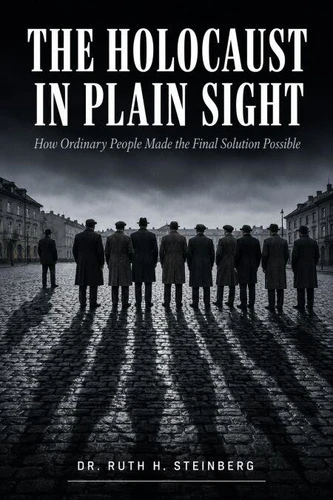
The Holocaust In Plain Sight: How Ordinary People Made the Final Solution Possible
Par :Formats :
Disponible dans votre compte client Decitre ou Furet du Nord dès validation de votre commande. Le format ePub est :
- Compatible avec une lecture sur My Vivlio (smartphone, tablette, ordinateur)
- Compatible avec une lecture sur liseuses Vivlio
- Pour les liseuses autres que Vivlio, vous devez utiliser le logiciel Adobe Digital Edition. Non compatible avec la lecture sur les liseuses Kindle, Remarkable et Sony
 , qui est-ce ?
Notre partenaire de plateforme de lecture numérique où vous retrouverez l'ensemble de vos ebooks gratuitement
Pour en savoir plus sur nos ebooks, consultez notre aide en ligne ici
C'est si simple ! Lisez votre ebook avec l'app Vivlio sur votre tablette, mobile ou ordinateur :

- FormatePub
- ISBN8235428317
- EAN9798235428317
- Date de parution05/06/2026
- Protection num.pas de protection
- Infos supplémentairesepub
- ÉditeurIoakim Ioakim
Résumé
The most dangerous thing about the Holocaust is not what it tells us about the Nazis. It is what it tells us about the rest of us. For eight decades, we have reached for the same consolation: that history's most documented genocide was carried out by monsters, by a pathological exception to the human norm, by perpetrators so psychologically alien that their actions belong to a different species of human experience.
Dr. Ruth H. Steinberg spent twenty years testing that consolation against the primary sources. It does not survive. What she found is worse. The men who shot 38, 000 Jews across occupied Poland were middle-aged family men from Hamburg, ordinary and unremarkable, called up late in the war because Germany needed bodies. On the morning of their first mass killing, their commanding officer offered them the chance to step out.
A handful did. The rest stayed and participated, not under threat of death, not under legal compulsion, but because their comrades were staying, because authority had given them permission, and because refusal felt more socially costly than murder. The death trains were scheduled by railway clerks filling out railway forms. The roundup of 13, 152 Jews in Paris on a July morning in 1942, including four thousand children, was organized and executed entirely by French police.
Jewish property was auctioned to German neighbors who knew precisely whose furniture they were buying. The Allied governments possessed detailed intelligence by late 1942 and convened a conference the following spring that was designed from the outset to produce no results. The Vatican knew. The Red Cross filed an understated report. The neighbors watched the deportation trains and asked no questions.
None of them were monsters. That is the central argument of this book, and it is the argument that makes this book so difficult to set down. The Holocaust in Plain Sight maps the complete architecture of complicity: from the senior bureaucrats who processed mass murder through a grammar of euphemism, to the French gendarmerie who rounded up Jewish families, to the German civilians who moved into vacated apartments and called it a normal Tuesday.
It draws on the foundational scholarship of Raul Hilberg, Christopher Browning, and Hannah Arendt, and on Stanley Milgram's devastating obedience research, which demonstrated that sixty-five percent of ordinary Americans would administer potentially lethal shocks to a stranger simply because a man in authority told them to. It also examines the people who refused, the rescuers and resisters scattered across occupied Europe, and asks what their example reveals about the choices available to everyone else.
The Holocaust happened in plain sight, in front of populations that chose, repeatedly and incrementally, to look the other way. Those conditions have not disappeared. They exist inside every organized society, including ours, waiting for the circumstances that make ordinary participation in atrocity feel normal, manageable, and justified. This is not a book about the worst of humanity. It is a book about all of us.
Dr. Ruth H. Steinberg spent twenty years testing that consolation against the primary sources. It does not survive. What she found is worse. The men who shot 38, 000 Jews across occupied Poland were middle-aged family men from Hamburg, ordinary and unremarkable, called up late in the war because Germany needed bodies. On the morning of their first mass killing, their commanding officer offered them the chance to step out.
A handful did. The rest stayed and participated, not under threat of death, not under legal compulsion, but because their comrades were staying, because authority had given them permission, and because refusal felt more socially costly than murder. The death trains were scheduled by railway clerks filling out railway forms. The roundup of 13, 152 Jews in Paris on a July morning in 1942, including four thousand children, was organized and executed entirely by French police.
Jewish property was auctioned to German neighbors who knew precisely whose furniture they were buying. The Allied governments possessed detailed intelligence by late 1942 and convened a conference the following spring that was designed from the outset to produce no results. The Vatican knew. The Red Cross filed an understated report. The neighbors watched the deportation trains and asked no questions.
None of them were monsters. That is the central argument of this book, and it is the argument that makes this book so difficult to set down. The Holocaust in Plain Sight maps the complete architecture of complicity: from the senior bureaucrats who processed mass murder through a grammar of euphemism, to the French gendarmerie who rounded up Jewish families, to the German civilians who moved into vacated apartments and called it a normal Tuesday.
It draws on the foundational scholarship of Raul Hilberg, Christopher Browning, and Hannah Arendt, and on Stanley Milgram's devastating obedience research, which demonstrated that sixty-five percent of ordinary Americans would administer potentially lethal shocks to a stranger simply because a man in authority told them to. It also examines the people who refused, the rescuers and resisters scattered across occupied Europe, and asks what their example reveals about the choices available to everyone else.
The Holocaust happened in plain sight, in front of populations that chose, repeatedly and incrementally, to look the other way. Those conditions have not disappeared. They exist inside every organized society, including ours, waiting for the circumstances that make ordinary participation in atrocity feel normal, manageable, and justified. This is not a book about the worst of humanity. It is a book about all of us.