
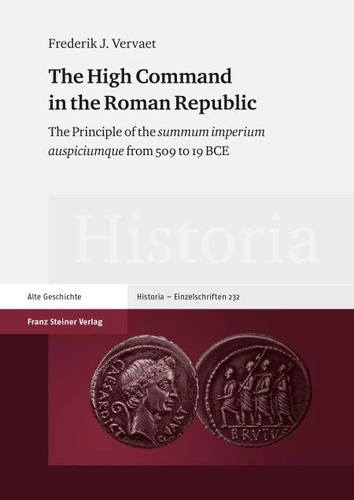
Frederik J. Vervaet (PhD Ghent University) is a Senior Lecturer in Ancient History at the University of Melbourne and specializes in Roman socio-institutional and political history, and Roman public law. He was a Research Fellow of the Research Foundation Flanders, Francqui Fellow of the Belgian American Educational Foundation at the University of California, Berkeley, Visiting Scholar at Wolfson College, Oxford, and Visiting Fellow of the Belgian Historical Institute in Rome at the Academia Belgica.
The High Command in the Roman Republic. The Principle of the summum imperium auspiciumque from 509 to 19 BCE
Par :Formats :
Disponible dans votre compte client Decitre ou Furet du Nord dès validation de votre commande. Le format PDF est :
- Compatible avec une lecture sur My Vivlio (smartphone, tablette, ordinateur)
- Compatible avec une lecture sur liseuses Vivlio
- Pour les liseuses autres que Vivlio, vous devez utiliser le logiciel Adobe Digital Edition. Non compatible avec la lecture sur les liseuses Kindle, Remarkable et Sony
 , qui est-ce ?
Notre partenaire de plateforme de lecture numérique où vous retrouverez l'ensemble de vos ebooks gratuitement
Pour en savoir plus sur nos ebooks, consultez notre aide en ligne ici
C'est si simple ! Lisez votre ebook avec l'app Vivlio sur votre tablette, mobile ou ordinateur :

- Nombre de pages369
- FormatPDF
- ISBN978-3-515-10788-4
- EAN9783515107884
- Date de parution21/10/2014
- Protection num.Digital Watermarking
- Taille2 Mo
- Infos supplémentairespdf
- ÉditeurFranz Steiner
Résumé
While the terminology has long been noted, the republican principle of the summum imperium auspiciumque, the high command and the prevailing auspices, has never been subject to comprehensive scrutiny. This enquiry for the first time identifies this principle as a coherent concept in Roman constitutional and administrative practice, being the senatorial oligarchy's foremost instrument to reconcile collegiate rule with the necessity of a unified high command.
After defining the relevant terms and the scope of the high command both in Rome and in the field, a number of case studies yield striking new insights into the constitutional ramifications for the allocation of public triumphs, the position of the consuls in the provinces, and the official hierarchy in combined commands, highlighting the fascinating interplay between these largely customary rules of engagement and the nobility's own code of honour.
This study also casts a provocative new light on how the high command was gradually monopolized by dynasts in the tumultuous period between Sulla's dictatorship and the emergence of the Augustan monarchy. Finally, a postscript addresses the vexed question of the lex curiata de imperio.
After defining the relevant terms and the scope of the high command both in Rome and in the field, a number of case studies yield striking new insights into the constitutional ramifications for the allocation of public triumphs, the position of the consuls in the provinces, and the official hierarchy in combined commands, highlighting the fascinating interplay between these largely customary rules of engagement and the nobility's own code of honour.
This study also casts a provocative new light on how the high command was gradually monopolized by dynasts in the tumultuous period between Sulla's dictatorship and the emergence of the Augustan monarchy. Finally, a postscript addresses the vexed question of the lex curiata de imperio.