
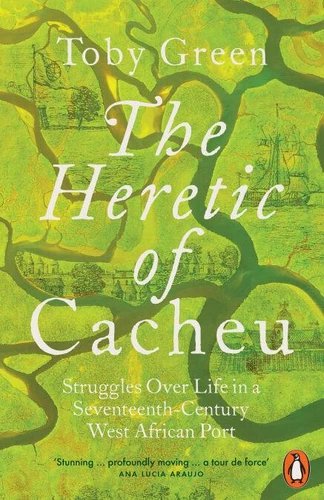
The Heretic of Cacheu. Struggles over Life in a Seventeenth-Century West African Port
Par :Formats :
Disponible dans votre compte client Decitre ou Furet du Nord dès validation de votre commande. Le format ePub protégé est :
- Compatible avec une lecture sur My Vivlio (smartphone, tablette, ordinateur)
- Compatible avec une lecture sur liseuses Vivlio
- Pour les liseuses autres que Vivlio, vous devez utiliser le logiciel Adobe Digital Edition. Non compatible avec la lecture sur les liseuses Kindle, Remarkable et Sony
- Non compatible avec un achat hors France métropolitaine
 , qui est-ce ?
Notre partenaire de plateforme de lecture numérique où vous retrouverez l'ensemble de vos ebooks gratuitement
Pour en savoir plus sur nos ebooks, consultez notre aide en ligne ici
C'est si simple ! Lisez votre ebook avec l'app Vivlio sur votre tablette, mobile ou ordinateur :

- Nombre de pages368
- FormatePub
- ISBN978-1-80206-159-8
- EAN9781802061598
- Date de parution03/07/2025
- Protection num.Adobe DRM
- Infos supplémentairesepub
- ÉditeurPenguin
Résumé
'A stunning global history of West Africa ... with this new tour de force, Green confirms himself as the most innovative historian, writer, and thinker of his generation' Ana Lucia Araujo, author of Humans in Shackles: An Atlantic History of SlaveryA unique, startling book that gives a rich and detailed sense of life in an African port some 360 years agoIn 1665 Crispina Peres, the most powerful trader in the West African slave trafficking port of Cacheu, was arrested by the Inquisition.
Her enemies had conspired to denounce her for taking treatments prescribed by Senegambian healers: the djabakós. But who was Peres? And why was the Portuguese Inquisition so concerned with policing the faith of a West African woman in today's Guinea-Bissau?In Cacheu Toby Green takes us to the heart of this conundrum, but also into the atmosphere of a very distant time and place. We learn how people in seventeenth-century Cacheu built their houses, what they wore, how they worshipped - and also the work they did, how they had fun, and how they healed themselves from illness.
Through this story, the haunting realities of the growing slave trade and the rise of European empires emerge in shocking detail. By the 1650s, the relationship between Europe, West Africa, and the Americas was already an old one, with slaving entrepots, colonies, and military bases interweaving over many generations. But Cacheu also challenged the dynamic. It was globally connected to places ranging from China and India to Brazil and Colombia, and women like Crispina Peres ran the town and challenged the patriarchy of empire.
For the first time, through the surviving documents recording Peres's case, we can see what this world was really like. Cacheu is an extraordinary act of historical recovery. It is the story of a seventeenth-century West African woman, but also of the shifting, sophisticated world in which she lived - its beliefs, values and people.
Her enemies had conspired to denounce her for taking treatments prescribed by Senegambian healers: the djabakós. But who was Peres? And why was the Portuguese Inquisition so concerned with policing the faith of a West African woman in today's Guinea-Bissau?In Cacheu Toby Green takes us to the heart of this conundrum, but also into the atmosphere of a very distant time and place. We learn how people in seventeenth-century Cacheu built their houses, what they wore, how they worshipped - and also the work they did, how they had fun, and how they healed themselves from illness.
Through this story, the haunting realities of the growing slave trade and the rise of European empires emerge in shocking detail. By the 1650s, the relationship between Europe, West Africa, and the Americas was already an old one, with slaving entrepots, colonies, and military bases interweaving over many generations. But Cacheu also challenged the dynamic. It was globally connected to places ranging from China and India to Brazil and Colombia, and women like Crispina Peres ran the town and challenged the patriarchy of empire.
For the first time, through the surviving documents recording Peres's case, we can see what this world was really like. Cacheu is an extraordinary act of historical recovery. It is the story of a seventeenth-century West African woman, but also of the shifting, sophisticated world in which she lived - its beliefs, values and people.
A propos de Toby Green

23,50 €