SOLDES
Jusqu'à -70% sur une sélection d'articles*

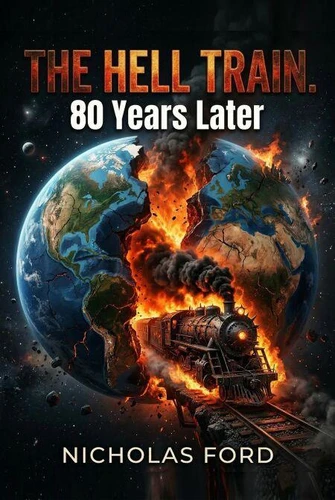
The Hell Train. 80 Years Later
Par :Formats :
Disponible dans votre compte client Decitre ou Furet du Nord dès validation de votre commande. Le format ePub est :
- Compatible avec une lecture sur My Vivlio (smartphone, tablette, ordinateur)
- Compatible avec une lecture sur liseuses Vivlio
- Pour les liseuses autres que Vivlio, vous devez utiliser le logiciel Adobe Digital Edition. Non compatible avec la lecture sur les liseuses Kindle, Remarkable et Sony
 , qui est-ce ?
Notre partenaire de plateforme de lecture numérique où vous retrouverez l'ensemble de vos ebooks gratuitement
Pour en savoir plus sur nos ebooks, consultez notre aide en ligne ici
C'est si simple ! Lisez votre ebook avec l'app Vivlio sur votre tablette, mobile ou ordinateur :

- FormatePub
- ISBN8232401191
- EAN9798232401191
- Date de parution22/03/2026
- Protection num.pas de protection
- Infos supplémentairesepub
- ÉditeurDraft2Digital
Résumé
"The Hell Train: 80 Years Later" is a book that poses a chilling question: How did a country that lost millions of lives fighting Nazism end up becoming the very thing it fought against? Nicholas Ford investigates by comparing the mechanisms of Third Reich totalitarianism with those of modern Russia, and uncovers a frightening similarity that cannot be ignored. History begins with an ideology of superiority.
In Nazi Germany, this was the racial theory of Aryan superiority, nourished by the occult teachings of the Thule Society and pseudoscientific theories. In Russia, this role is played by the metaphysical doctrine of the "Russian World"-the concept of the "God-bearing people, " the formula "Moscow-the Third Rome, " which transforms geopolitics into a religious war of good against evil. The philosophical ideas of Solovyov and Berdyaev have been vulgarized into imperial revanchism, while the works of Ivan Ilyin, who openly sympathized with fascism, have become an important text of state ideology.
The second pillar of tyranny is religion as an instrument of power. In Germany, the "German Christians" movement, which called itself the "Stormtroopers of Jesus Christ, " demanded that the Old Testament be removed from the Bible and that Christ be turned into an Aryan warrior. In Russia, the Russian Orthodox Church, having monopolized the spiritual sphere with unprecedented state support, preaches Orthodox fundamentalism, sanctifies war, and blesses weapons.
Priests in camouflage consecrate tanks, turning the army into 21st-century crusaders. The third mechanism is the suppression of any dissent. In Germany, Pastor Walter Künneth established the "Apologetic Center, " which provided the Gestapo with expert reports against "sects" and dissidents. In Russia, this role is fulfilled by RACIRS under the leadership of Alexander Dvorkin-an organization that compiles blacklists and provides pseudoscientific expert reports to the FSB and the courts.
A mechanism honed on religious minorities-Jehovah's Witnesses, Protestants-has been scaled up to destroy any opposition. The fourth pillar is total propaganda. Goebbels' Ministry, with its "big lie" and demonization of enemies, has been resurrected in Russia's "Matrix Z"-a hermetic information environment where, for eight years, Ukraine was turned into a "nest of neo-Nazism" and a "sectarian state, " while the war was declared a "holy battle against the satanic West." Laws on "fake news" and the "foreign agent" label silenced the last remaining critics.
The culmination is the "Decree" document of the World Russian People's Council, which officially designates the invasion of Ukraine as a "Holy War." Russia is declared the "Holder"-a mystical force opposing the apocalypse-while the West is the embodiment of Satanism. Nicholas Ford concludes: all four pillars of the Nazi regime have been recreated with drafting precision. This is not a historical coincidence, but a deliberate use of the past as a blueprint for building totalitarianism.
The metaphor of a hellish train hurtling toward the abyss permeates every page-and on this train is all of humanity, teetering on the brink of nuclear catastrophe. The book is an appeal to everyone: to recognize the nature of evil, to call things by their proper names, and not to repeat the fatal mistake of Munich in 1938, when attempts to appease the aggressor led to a global catastrophe.
In Nazi Germany, this was the racial theory of Aryan superiority, nourished by the occult teachings of the Thule Society and pseudoscientific theories. In Russia, this role is played by the metaphysical doctrine of the "Russian World"-the concept of the "God-bearing people, " the formula "Moscow-the Third Rome, " which transforms geopolitics into a religious war of good against evil. The philosophical ideas of Solovyov and Berdyaev have been vulgarized into imperial revanchism, while the works of Ivan Ilyin, who openly sympathized with fascism, have become an important text of state ideology.
The second pillar of tyranny is religion as an instrument of power. In Germany, the "German Christians" movement, which called itself the "Stormtroopers of Jesus Christ, " demanded that the Old Testament be removed from the Bible and that Christ be turned into an Aryan warrior. In Russia, the Russian Orthodox Church, having monopolized the spiritual sphere with unprecedented state support, preaches Orthodox fundamentalism, sanctifies war, and blesses weapons.
Priests in camouflage consecrate tanks, turning the army into 21st-century crusaders. The third mechanism is the suppression of any dissent. In Germany, Pastor Walter Künneth established the "Apologetic Center, " which provided the Gestapo with expert reports against "sects" and dissidents. In Russia, this role is fulfilled by RACIRS under the leadership of Alexander Dvorkin-an organization that compiles blacklists and provides pseudoscientific expert reports to the FSB and the courts.
A mechanism honed on religious minorities-Jehovah's Witnesses, Protestants-has been scaled up to destroy any opposition. The fourth pillar is total propaganda. Goebbels' Ministry, with its "big lie" and demonization of enemies, has been resurrected in Russia's "Matrix Z"-a hermetic information environment where, for eight years, Ukraine was turned into a "nest of neo-Nazism" and a "sectarian state, " while the war was declared a "holy battle against the satanic West." Laws on "fake news" and the "foreign agent" label silenced the last remaining critics.
The culmination is the "Decree" document of the World Russian People's Council, which officially designates the invasion of Ukraine as a "Holy War." Russia is declared the "Holder"-a mystical force opposing the apocalypse-while the West is the embodiment of Satanism. Nicholas Ford concludes: all four pillars of the Nazi regime have been recreated with drafting precision. This is not a historical coincidence, but a deliberate use of the past as a blueprint for building totalitarianism.
The metaphor of a hellish train hurtling toward the abyss permeates every page-and on this train is all of humanity, teetering on the brink of nuclear catastrophe. The book is an appeal to everyone: to recognize the nature of evil, to call things by their proper names, and not to repeat the fatal mistake of Munich in 1938, when attempts to appease the aggressor led to a global catastrophe.