SOLDES
Jusqu'à -70% sur une sélection d'articles*

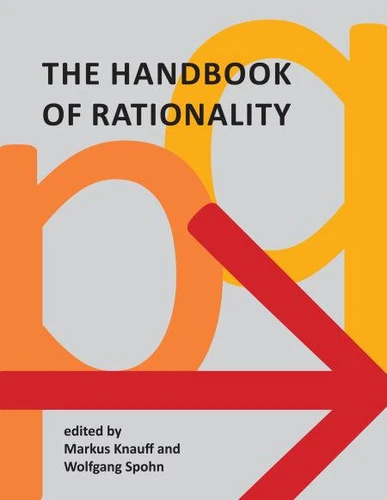
The Handbook of Rationality
Par : ,Formats :
Disponible dans votre compte client Decitre ou Furet du Nord dès validation de votre commande. Le format ePub protégé est :
- Compatible avec une lecture sur My Vivlio (smartphone, tablette, ordinateur)
- Compatible avec une lecture sur liseuses Vivlio
- Pour les liseuses autres que Vivlio, vous devez utiliser le logiciel Adobe Digital Edition. Non compatible avec la lecture sur les liseuses Kindle, Remarkable et Sony
- Non compatible avec un achat hors France métropolitaine
 , qui est-ce ?
Notre partenaire de plateforme de lecture numérique où vous retrouverez l'ensemble de vos ebooks gratuitement
Pour en savoir plus sur nos ebooks, consultez notre aide en ligne ici
C'est si simple ! Lisez votre ebook avec l'app Vivlio sur votre tablette, mobile ou ordinateur :

- Nombre de pages880
- FormatePub
- ISBN978-0-262-36185-9
- EAN9780262361859
- Date de parution14/12/2021
- Protection num.Adobe DRM
- Taille20 Mo
- Infos supplémentairesepub
- ÉditeurThe MIT Press
Résumé
The first reference on rationality that integrates accounts from psychology and philosophy, covering descriptive and normative theories from both disciplines. Both analytic philosophy and cognitive psychology have made dramatic advances in understanding rationality, but there has been little interaction between the disciplines. This volume offers the first integrated overview of the state of the art in the psychology and philosophy of rationality.
Written by leading experts from both disciplines, The Handbook of Rationality covers the main normative and descriptive theories of rationality-how people ought to think, how they actually think, and why we often deviate from what we can call rational. It also offers insights from other fields such as artificial intelligence, economics, the social sciences, and cognitive neuroscience. The Handbook proposes a novel classification system for researchers in human rationality, and it creates new connections between rationality research in philosophy, psychology, and other disciplines.
Following the basic distinction between theoretical and practical rationality, the book first considers the theoretical side, including normative and descriptive theories of logical, probabilistic, causal, and defeasible reasoning. It then turns to the practical side, discussing topics such as decision making, bounded rationality, game theory, deontic and legal reasoning, and the relation between rationality and morality.
Finally, it covers topics that arise in both theoretical and practical rationality, including visual and spatial thinking, scientific rationality, how children learn to reason rationally, and the connection between intelligence and rationality.
Written by leading experts from both disciplines, The Handbook of Rationality covers the main normative and descriptive theories of rationality-how people ought to think, how they actually think, and why we often deviate from what we can call rational. It also offers insights from other fields such as artificial intelligence, economics, the social sciences, and cognitive neuroscience. The Handbook proposes a novel classification system for researchers in human rationality, and it creates new connections between rationality research in philosophy, psychology, and other disciplines.
Following the basic distinction between theoretical and practical rationality, the book first considers the theoretical side, including normative and descriptive theories of logical, probabilistic, causal, and defeasible reasoning. It then turns to the practical side, discussing topics such as decision making, bounded rationality, game theory, deontic and legal reasoning, and the relation between rationality and morality.
Finally, it covers topics that arise in both theoretical and practical rationality, including visual and spatial thinking, scientific rationality, how children learn to reason rationally, and the connection between intelligence and rationality.