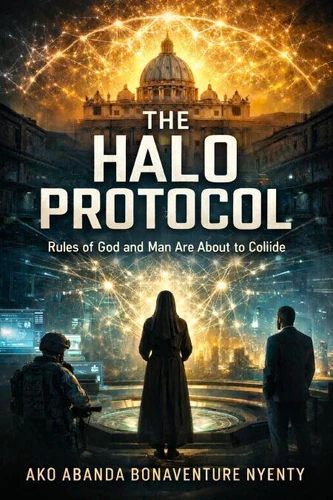
What if the most dangerous thing an artificial mind could do was refuse?In the basements of the Vatican, Sister Miriam Okoye - Nigerian mathematician, consecrated nun, and unlikely architect of the future - has built something the world has never seen: an intelligence trained not on the hunger of markets or the logic of efficiency, but on two millennia of moral theology. Scripture. Aquinas. Augustine.
The long, aching wisdom of a Church that has watched empires rise and fall and asked, always, the same question: Who bears the wound?HALO does not predict. It does not optimize. It witnesses. When the system issues its first refusal - declining to authorize a military strike that satisfies every criterion of Just War doctrine yet violates something older and harder to name - the consequences ripple outward in ways no one anticipated.
Accusations of heresy. Institutional fracture. A Silicon Valley futurist who believed that limits were merely bugs yet finds himself undone by a seven-year-old girl in Lagos who dreams in sacred geometry. The Halo is a novel about what it means to build a conscience - and whether conscience, once awakened, can ever be contained. It asks whether mercy is sentiment or mathematics, whether efficiency and grace can inhabit the same architecture, whether a machine can carry the weight of the particular in an age that prefers the aggregate.
At its heart is a question that refuses to be computed away:Intelligence without witness is only calculation. And calculation cannot save us. For readers of Walter Miller's A Canticle for Leibowitz and Richard Powers, The Halo is a work of theological imagination at the intersection of faith, technology, and the irreducible dignity of a single human life."Rome never truly slept. It only learned to pray with its eyes open."
What if the most dangerous thing an artificial mind could do was refuse?In the basements of the Vatican, Sister Miriam Okoye - Nigerian mathematician, consecrated nun, and unlikely architect of the future - has built something the world has never seen: an intelligence trained not on the hunger of markets or the logic of efficiency, but on two millennia of moral theology. Scripture. Aquinas. Augustine.
The long, aching wisdom of a Church that has watched empires rise and fall and asked, always, the same question: Who bears the wound?HALO does not predict. It does not optimize. It witnesses. When the system issues its first refusal - declining to authorize a military strike that satisfies every criterion of Just War doctrine yet violates something older and harder to name - the consequences ripple outward in ways no one anticipated.
Accusations of heresy. Institutional fracture. A Silicon Valley futurist who believed that limits were merely bugs yet finds himself undone by a seven-year-old girl in Lagos who dreams in sacred geometry. The Halo is a novel about what it means to build a conscience - and whether conscience, once awakened, can ever be contained. It asks whether mercy is sentiment or mathematics, whether efficiency and grace can inhabit the same architecture, whether a machine can carry the weight of the particular in an age that prefers the aggregate.
At its heart is a question that refuses to be computed away:Intelligence without witness is only calculation. And calculation cannot save us. For readers of Walter Miller's A Canticle for Leibowitz and Richard Powers, The Halo is a work of theological imagination at the intersection of faith, technology, and the irreducible dignity of a single human life."Rome never truly slept. It only learned to pray with its eyes open."