SOLDES
Jusqu'à -70% sur une sélection d'articles*

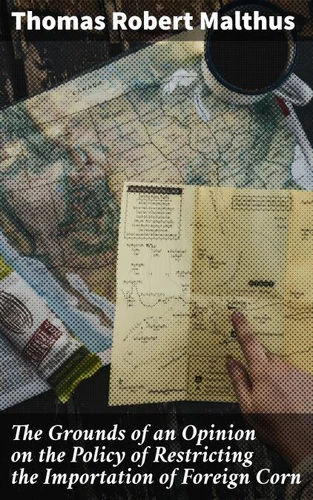
The Grounds of an Opinion on the Policy of Restricting the Importation of Foreign Corn. Navigating Trade Policies in Early 19th Century Economy
Par :Formats :
Disponible dans votre compte client Decitre ou Furet du Nord dès validation de votre commande. Le format ePub est :
- Compatible avec une lecture sur My Vivlio (smartphone, tablette, ordinateur)
- Compatible avec une lecture sur liseuses Vivlio
- Pour les liseuses autres que Vivlio, vous devez utiliser le logiciel Adobe Digital Edition. Non compatible avec la lecture sur les liseuses Kindle, Remarkable et Sony
 , qui est-ce ?
Notre partenaire de plateforme de lecture numérique où vous retrouverez l'ensemble de vos ebooks gratuitement
Pour en savoir plus sur nos ebooks, consultez notre aide en ligne ici
C'est si simple ! Lisez votre ebook avec l'app Vivlio sur votre tablette, mobile ou ordinateur :

- Nombre de pages27
- FormatePub
- ISBN406-4-06-642133-5
- EAN4064066421335
- Date de parution08/12/2020
- Protection num.Digital Watermarking
- Taille622 Ko
- Infos supplémentairesepub
- ÉditeurGOOD PRESS
Résumé
Thomas Robert Malthus'Äôs seminal work, "The Grounds of an Opinion on the Policy of Restricting the Importation of Foreign Corn, " presents a fervent discourse on the complex interplay between population dynamics and agricultural policy. Written in 1815, this treatise employs a rigorous blend of empirical analysis and theoretical frameworks to argue against unrestricted corn importation, positing that such policies could exacerbate national dependency and undermine domestic agricultural productivity.
Malthus'Äô literary style combines eloquence with lucidity, reflecting the age of Enlightenment where reason informed policy discussions. His insights into supply, demand, and the consequences of population growth situate this work within the larger context of economic thought during the late 18th and early 19th centuries, foreshadowing later debates on food security and trade policies. Malthus, an English cleric and economist, is perhaps best known for his Malthusian theory of population growth, which played a pivotal role in the development of economic and demographic theories.
His academic background in the natural sciences and moral philosophy undoubtedly shaped his view of the potential pitfalls of unfettered importation, allowing him to integrate ethical considerations with economic analysis. The pressing issue of famine and agricultural failure in his time propelled him to articulate these concerns in a manner that underscores the urgency of responsible governance. For readers interested in the intersections of economic thought, agricultural policy, and social ethics, Malthus'Äôs work is indispensable.
It not only illuminates the reasoning behind protectionist policies but also invites contemporary discussions on food security, sustainability, and the socio-economic implications of agriculture. Engaging with Malthus'Äôs ideas will deepen one'Äôs understanding of the historical roots of modern economic discourse and the perennial challenges of resource management.
Malthus'Äô literary style combines eloquence with lucidity, reflecting the age of Enlightenment where reason informed policy discussions. His insights into supply, demand, and the consequences of population growth situate this work within the larger context of economic thought during the late 18th and early 19th centuries, foreshadowing later debates on food security and trade policies. Malthus, an English cleric and economist, is perhaps best known for his Malthusian theory of population growth, which played a pivotal role in the development of economic and demographic theories.
His academic background in the natural sciences and moral philosophy undoubtedly shaped his view of the potential pitfalls of unfettered importation, allowing him to integrate ethical considerations with economic analysis. The pressing issue of famine and agricultural failure in his time propelled him to articulate these concerns in a manner that underscores the urgency of responsible governance. For readers interested in the intersections of economic thought, agricultural policy, and social ethics, Malthus'Äôs work is indispensable.
It not only illuminates the reasoning behind protectionist policies but also invites contemporary discussions on food security, sustainability, and the socio-economic implications of agriculture. Engaging with Malthus'Äôs ideas will deepen one'Äôs understanding of the historical roots of modern economic discourse and the perennial challenges of resource management.