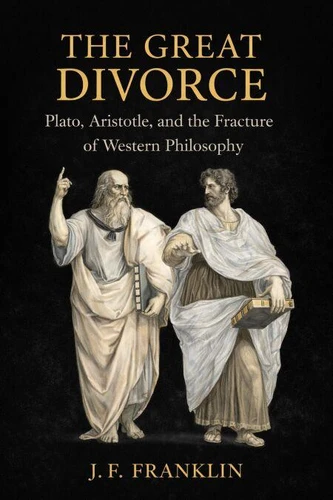
The Great Divorce Plato, Aristotle, and the Fracture of Western Philosophy In 367 BCE, a seventeen-year-old boy from Macedonia arrived at Plato's Academy in Athens. For the next twenty years, Aristotle would study under the master, becoming the most brilliant student the Academy had ever seen. But when Plato died in 347 BCE, something unexpected happened: Aristotle did not inherit the Academy. Instead, he left Athens and eventually founded a rival school, developing a philosophy that contradicted his teacher's at almost every turn. This was not merely a personal falling-out.
It was the beginning of the most consequential intellectual divorce in Western history, a split that would echo through twenty-four centuries, shaping everything from medieval theology to modern science, from the Enlightenment to contemporary debates about artificial intelligence, from political theory to how we understand our own minds. The Great Divorce tells the story of how two of history's greatest minds disagreed about the most fundamental questions: What is real? How do we know? What makes life worth living? Plato believed in eternal Forms accessible through reason; Aristotle insisted on studying the particular things we can observe.
Plato sought truth in mathematics and abstract contemplation; Aristotle found it in careful observation of nature. Plato designed ideal republics ruled by philosophers; Aristotle analyzed how actual constitutions function. Their disagreement was not resolved. Instead, it became embedded in the structure of Western thought. Christianity adopted Plato for eight centuries before Aristotle returned through Islamic scholars, sparking a medieval crisis.
The Scientific Revolution succeeded by combining Platonic mathematics with Aristotelian observation, a hybrid neither philosopher would have recognized. Modern philosophy split into rationalism and empiricism, idealism and materialism, each claiming descent from one or the other ancient master. Today, the divide persists in debates about whether mathematical objects are real, whether consciousness can be explained physically, whether justice is universal or culturally relative. But The Great Divorce argues that this fracture was not a failure but a necessity.
The tension between Plato and Aristotle, between ideal and real, universal and particular, reason and experience reflects a genuine duality in how humans must approach truth. We need both philosophers because reality itself requires multiple perspectives. The divorce remains productive precisely because it remains unresolved. Drawing on philosophy, history, and science, this book offers both a gripping narrative of the teacher-student relationship that shaped civilization and a guide to navigating the intellectual choices we all face.
When should we trust abstract reasoning, when concrete observation? When should we pursue ideals, when accommodate reality? The ancient debate is not merely academic, it structures how we think, work, and live. Accessible to general readers yet rigorous in its scholarship, The Great Divorce illuminates the past to help us understand the present. It shows how the questions Plato and Aristotle raised in the Academy gardens remain our questions, how their answers remain our options, and how wisdom lies not in choosing between them but in learning to live with both.
The Great Divorce Plato, Aristotle, and the Fracture of Western Philosophy In 367 BCE, a seventeen-year-old boy from Macedonia arrived at Plato's Academy in Athens. For the next twenty years, Aristotle would study under the master, becoming the most brilliant student the Academy had ever seen. But when Plato died in 347 BCE, something unexpected happened: Aristotle did not inherit the Academy. Instead, he left Athens and eventually founded a rival school, developing a philosophy that contradicted his teacher's at almost every turn. This was not merely a personal falling-out.
It was the beginning of the most consequential intellectual divorce in Western history, a split that would echo through twenty-four centuries, shaping everything from medieval theology to modern science, from the Enlightenment to contemporary debates about artificial intelligence, from political theory to how we understand our own minds. The Great Divorce tells the story of how two of history's greatest minds disagreed about the most fundamental questions: What is real? How do we know? What makes life worth living? Plato believed in eternal Forms accessible through reason; Aristotle insisted on studying the particular things we can observe.
Plato sought truth in mathematics and abstract contemplation; Aristotle found it in careful observation of nature. Plato designed ideal republics ruled by philosophers; Aristotle analyzed how actual constitutions function. Their disagreement was not resolved. Instead, it became embedded in the structure of Western thought. Christianity adopted Plato for eight centuries before Aristotle returned through Islamic scholars, sparking a medieval crisis.
The Scientific Revolution succeeded by combining Platonic mathematics with Aristotelian observation, a hybrid neither philosopher would have recognized. Modern philosophy split into rationalism and empiricism, idealism and materialism, each claiming descent from one or the other ancient master. Today, the divide persists in debates about whether mathematical objects are real, whether consciousness can be explained physically, whether justice is universal or culturally relative. But The Great Divorce argues that this fracture was not a failure but a necessity.
The tension between Plato and Aristotle, between ideal and real, universal and particular, reason and experience reflects a genuine duality in how humans must approach truth. We need both philosophers because reality itself requires multiple perspectives. The divorce remains productive precisely because it remains unresolved. Drawing on philosophy, history, and science, this book offers both a gripping narrative of the teacher-student relationship that shaped civilization and a guide to navigating the intellectual choices we all face.
When should we trust abstract reasoning, when concrete observation? When should we pursue ideals, when accommodate reality? The ancient debate is not merely academic, it structures how we think, work, and live. Accessible to general readers yet rigorous in its scholarship, The Great Divorce illuminates the past to help us understand the present. It shows how the questions Plato and Aristotle raised in the Academy gardens remain our questions, how their answers remain our options, and how wisdom lies not in choosing between them but in learning to live with both.

 , qui est-ce ?