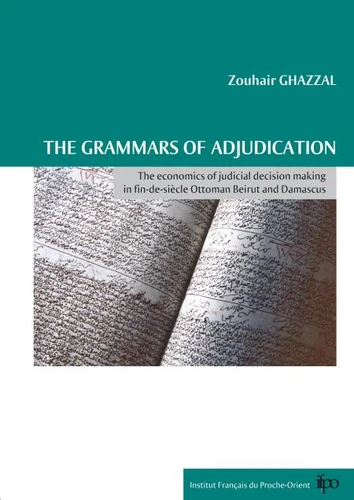
The grammars of adjudication. The economics of judicial decision making in fin-de-siècle Ottoman Beirut and Damascus
Par :Formats :
Disponible dans votre compte client Decitre ou Furet du Nord dès validation de votre commande. Le format Multi-format est :
- Pour les liseuses autres que Vivlio, vous devez utiliser le logiciel Adobe Digital Edition. Non compatible avec la lecture sur les liseuses Kindle, Remarkable et Sony
 , qui est-ce ?
Notre partenaire de plateforme de lecture numérique où vous retrouverez l'ensemble de vos ebooks gratuitement
Pour en savoir plus sur nos ebooks, consultez notre aide en ligne ici
C'est si simple ! Lisez votre ebook avec l'app Vivlio sur votre tablette, mobile ou ordinateur :

- Nombre de pages745
- FormatMulti-format
- ISBN978-2-35159-269-4
- EAN9782351592694
- Date de parution01/06/2008
- Protection num.pas de protection
- Infos supplémentairesMulti-Format
- ÉditeurPresses de l'IFPO
Résumé
Most studies on Islamic, Arab, and Ottoman societies and civilizations are trapped into the evidentiary role of the texts that researchers have at their disposal, considerably reducing the role of text and language to a mimetic description of what happened. This book argues that an understanding of social relations primarily implies taking into consideration the textual production of society in terms of the meanings that could be ascribed to the texts themselves, and, second, that the analysis of texts, whatever their societal and institutional contexts, should look at its sources as discursive practices, in order not to reduce them to their preliminary role of bearers of factual evidence.
Drawing from a large variety of Ottoman "legal" texts from nineteenth-century Beirut and Damascus, this book avoids ascribing such texts to the normative values of "Islamic law, " by documenting instead how various discursive practices concretely operate within a particular terrain. Different levels of practises therefore emerge, all of which documented by the social actors that made their existence possible.
Drawing from a large variety of Ottoman "legal" texts from nineteenth-century Beirut and Damascus, this book avoids ascribing such texts to the normative values of "Islamic law, " by documenting instead how various discursive practices concretely operate within a particular terrain. Different levels of practises therefore emerge, all of which documented by the social actors that made their existence possible.