The complete narrative history of World War II - Pearl Harbor, D-Day, the atomic bomb, Rosie the Riveter, the Double V Campaign, and the war that made modern America, 1939-1945.
On September 1, 1939, fifty-three German divisions crossed the Polish frontier at dawn. The Blitzkrieg destroyed the Polish air force on the ground and reached Warsaw within eight days. The United States watched from four thousand miles away, separated by the Atlantic and by a fierce conviction that Europe's catastrophes were not America's to solve.
The memory of 116, 000 Americans dead in a war that had settled nothing had calcified into policy: neutrality, isolation, the belief that the oceans were barriers rather than highways.
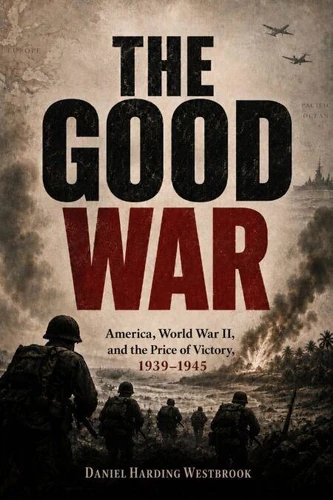
Across twenty-four chapters, historian Daniel Harding Westbrook traces the full American experience in World War II - from the isolationist debate, Lend-Lease, and Pearl Harbor through Midway, D-Day, the firebombing of Tokyo, and the atomic bombs at Hiroshima and Nagasaki - and the homefront mobilization, Japanese American internment, the Double V Campaign, and the GI Bill that built the postwar middle class.
Inside this World War II history:
Lend-Lease and the arsenal of democracy - how Roosevelt's fireside chat reached sixty million Americans, $50 billion in aid reached Britain and the Soviet Union, and the undeclared naval war cost the USS Reuben James 115 dead (Chapters 3-4)
Pearl Harbor - Commander Fuchida's "Tora! Tora! Tora!" signal, the Arizona's million pounds of powder detonating in nine minutes, and the 1, 177 men still entombed beneath the harbor (Chapter 4)
Midway and island-hopping - the Pacific turning point, and Iwo Jima's 26, 000 Marine casualties in thirty-six days of the bloodiest battle in Marine Corps history (Chapters 9-10)
The firebombing of Tokyo - Curtis LeMay's 334 B-29s burning sixteen square miles in a single night, 80, 000-100, 000 dead, and the moral logic of industrial-age air war (Chapter 11)
The atomic bomb - Trinity in the New Mexico desert on July 16, 1945, Hiroshima on August 6, Nagasaki on August 9, and Oppenheimer's Bhagavad Gita recollection (Chapter 12)
Women and the Double V - Rosie the Riveter's 1, 074 WASP pilots flying 60 million miles in 78 aircraft types, and the Pittsburgh Courier's Double V Campaign demanding two victories: against the Axis and against Jim Crow (Chapters 17-18)
The GI Bill and the Greatest Generation - how veterans' education and housing benefits built the postwar middle class, and how the mythology of the "Good War" shaped American self-understanding (Chapters 22, 24)
World War II was the event that made modern America - the industrial power, the international commitments, the racial contradictions, and the self-image as a nation that fights for democracy and sometimes fails to practice it.
Westbrook's account delivers the military narrative and the human one: the soldiers, the factory workers, the Japanese Americans in internment camps, and the Black veterans who came home demanding the democracy they had fought for abroad.
For readers of Rick Atkinson's THE GUNS AT LAST LIGHT and Doris Kearns Goodwin's NO ORDINARY TIME.
The complete narrative history of World War II - Pearl Harbor, D-Day, the atomic bomb, Rosie the Riveter, the Double V Campaign, and the war that made modern America, 1939-1945.
On September 1, 1939, fifty-three German divisions crossed the Polish frontier at dawn. The Blitzkrieg destroyed the Polish air force on the ground and reached Warsaw within eight days. The United States watched from four thousand miles away, separated by the Atlantic and by a fierce conviction that Europe's catastrophes were not America's to solve.
The memory of 116, 000 Americans dead in a war that had settled nothing had calcified into policy: neutrality, isolation, the belief that the oceans were barriers rather than highways.
Across twenty-four chapters, historian Daniel Harding Westbrook traces the full American experience in World War II - from the isolationist debate, Lend-Lease, and Pearl Harbor through Midway, D-Day, the firebombing of Tokyo, and the atomic bombs at Hiroshima and Nagasaki - and the homefront mobilization, Japanese American internment, the Double V Campaign, and the GI Bill that built the postwar middle class.
Inside this World War II history:
Lend-Lease and the arsenal of democracy - how Roosevelt's fireside chat reached sixty million Americans, $50 billion in aid reached Britain and the Soviet Union, and the undeclared naval war cost the USS Reuben James 115 dead (Chapters 3-4)
Pearl Harbor - Commander Fuchida's "Tora! Tora! Tora!" signal, the Arizona's million pounds of powder detonating in nine minutes, and the 1, 177 men still entombed beneath the harbor (Chapter 4)
Midway and island-hopping - the Pacific turning point, and Iwo Jima's 26, 000 Marine casualties in thirty-six days of the bloodiest battle in Marine Corps history (Chapters 9-10)
The firebombing of Tokyo - Curtis LeMay's 334 B-29s burning sixteen square miles in a single night, 80, 000-100, 000 dead, and the moral logic of industrial-age air war (Chapter 11)
The atomic bomb - Trinity in the New Mexico desert on July 16, 1945, Hiroshima on August 6, Nagasaki on August 9, and Oppenheimer's Bhagavad Gita recollection (Chapter 12)
Women and the Double V - Rosie the Riveter's 1, 074 WASP pilots flying 60 million miles in 78 aircraft types, and the Pittsburgh Courier's Double V Campaign demanding two victories: against the Axis and against Jim Crow (Chapters 17-18)
The GI Bill and the Greatest Generation - how veterans' education and housing benefits built the postwar middle class, and how the mythology of the "Good War" shaped American self-understanding (Chapters 22, 24)
World War II was the event that made modern America - the industrial power, the international commitments, the racial contradictions, and the self-image as a nation that fights for democracy and sometimes fails to practice it.
Westbrook's account delivers the military narrative and the human one: the soldiers, the factory workers, the Japanese Americans in internment camps, and the Black veterans who came home demanding the democracy they had fought for abroad.
For readers of Rick Atkinson's THE GUNS AT LAST LIGHT and Doris Kearns Goodwin's NO ORDINARY TIME.

 , qui est-ce ?
