
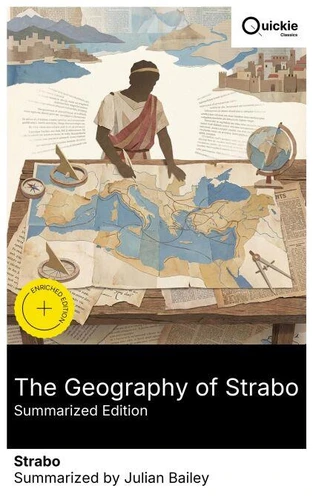
The Geography of Strabo (Summarized Edition). Enriched edition. A Hellenistic-Roman survey of the Mediterranean: cartography, ethnography, and topography from Asia Minor to Italy under Augustan rule
Par : , , ,Formats :
Disponible dans votre compte client Decitre ou Furet du Nord dès validation de votre commande. Le format ePub est :
- Compatible avec une lecture sur My Vivlio (smartphone, tablette, ordinateur)
- Compatible avec une lecture sur liseuses Vivlio
- Pour les liseuses autres que Vivlio, vous devez utiliser le logiciel Adobe Digital Edition. Non compatible avec la lecture sur les liseuses Kindle, Remarkable et Sony
 , qui est-ce ?
Notre partenaire de plateforme de lecture numérique où vous retrouverez l'ensemble de vos ebooks gratuitement
Pour en savoir plus sur nos ebooks, consultez notre aide en ligne ici
C'est si simple ! Lisez votre ebook avec l'app Vivlio sur votre tablette, mobile ou ordinateur :

- Nombre de pages397
- FormatePub
- ISBN859-65--4787815-5
- EAN8596547878155
- Date de parution10/01/2026
- Protection num.Digital Watermarking
- Taille954 Ko
- Infos supplémentairesepub
- ÉditeurQUICKIE CLASSICS
Résumé
These opening volumes of The Geography of Strabo present an ambitious synthesis: a survey of the known world that joins mathematical cartography to ethnographic narrative. Strabo expounds method, critiques Homer, Eratosthenes, Polybius, and Hipparchus, and proceeds through the western Mediterranean and Italy, recording topography, resources, myths, and routes. His style, poised between periegesis and historiography, favors sober evaluation over marvels, yet preserves travel lore and local memory.
Framed by Augustan rule, the work measures distance, climate, and custom against new imperial networks. Strabo of Amasia (c. 64 BCE-after 24 CE) studied grammar, rhetoric, and Stoic thought, and traveled from Asia Minor and the Black Sea to Egypt and Rome. Drawing on a scholar's library and eyewitness itineraries, he blends Hellenistic criticism with Augustan pragmatism, insisting on measured distances, trustworthy authorities, and geography's civic uses.
These volumes suit classicists, historians of science, and readers of travel writing alike, illuminating ancient spatial thought at the hinge of Hellenistic and Roman worlds. Read it for its clear method, disciplined curiosity, and enduring claim that geography is knowledge for action. Quickie Classics summarizes timeless works with precision, preserving the author's voice and keeping the prose clear, fast, and readable-distilled, never diluted.
Enriched Edition extras: Introduction · Synopsis · Historical Context · Author Biography · Brief Analysis · 4 Reflection Q&As · Editorial Footnotes.
Framed by Augustan rule, the work measures distance, climate, and custom against new imperial networks. Strabo of Amasia (c. 64 BCE-after 24 CE) studied grammar, rhetoric, and Stoic thought, and traveled from Asia Minor and the Black Sea to Egypt and Rome. Drawing on a scholar's library and eyewitness itineraries, he blends Hellenistic criticism with Augustan pragmatism, insisting on measured distances, trustworthy authorities, and geography's civic uses.
These volumes suit classicists, historians of science, and readers of travel writing alike, illuminating ancient spatial thought at the hinge of Hellenistic and Roman worlds. Read it for its clear method, disciplined curiosity, and enduring claim that geography is knowledge for action. Quickie Classics summarizes timeless works with precision, preserving the author's voice and keeping the prose clear, fast, and readable-distilled, never diluted.
Enriched Edition extras: Introduction · Synopsis · Historical Context · Author Biography · Brief Analysis · 4 Reflection Q&As · Editorial Footnotes.
A propos de Strabo

0,99 €