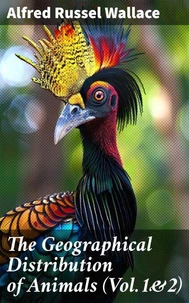
The Geographical Distribution of Animals (Summarized Edition). Enriched edition. Mapping six zoogeographic realms: geology, climate, and barriers shaping global species distributions
Par : ,Formats :
Disponible dans votre compte client Decitre ou Furet du Nord dès validation de votre commande. Le format ePub est :
- Compatible avec une lecture sur My Vivlio (smartphone, tablette, ordinateur)
- Compatible avec une lecture sur liseuses Vivlio
- Pour les liseuses autres que Vivlio, vous devez utiliser le logiciel Adobe Digital Edition. Non compatible avec la lecture sur les liseuses Kindle, Remarkable et Sony
 , qui est-ce ?
Notre partenaire de plateforme de lecture numérique où vous retrouverez l'ensemble de vos ebooks gratuitement
Pour en savoir plus sur nos ebooks, consultez notre aide en ligne ici
C'est si simple ! Lisez votre ebook avec l'app Vivlio sur votre tablette, mobile ou ordinateur :

- Nombre de pages280
- FormatePub
- ISBN859-65--4787814-8
- EAN8596547878148
- Date de parution10/01/2026
- Protection num.Digital Watermarking
- Taille879 Ko
- Infos supplémentairesepub
- ÉditeurQUICKIE CLASSICS
Résumé
First published in 1876, this two-volume treatise codifies the world's fauna into six zoogeographic realms: Palearctic, Nearctic, Neotropical, Ethiopian, Oriental, and Australasian, and explains their boundaries through geology, climate, and barriers to dispersal. Wallace integrates exhaustive catalogues with interpretive chapters, using maps, synoptic tables, and bathymetric clues such as shallow seas to infer past connections.
Extending P. L. Sclater's avian scheme to vertebrates, his methodical prose offers a Darwinian, historical account that makes biogeography a synthetic science. Wallace's argument grows from lived experience. Years in the Amazon and the Malay Archipelago, where he traced the Wallace Line between Bali and Lombok, gave him intimate knowledge of island faunas, endemism, and migration barriers. As co-formulator of natural selection and an indefatigable collector for museums, he turned field notes, specimen lists, and correspondence with Darwin, Huxley, and Sclater into a principled framework for why species occur where they do.
Scholars of evolution, macroecology, and the history of science will find this foundational synthesis indispensable; conservationists and systematists will value its durable logic and global scope. Read it for empirical rigor and conceptual clarity: a master class in converting natural history into theory, and in learning to read the map of life. Quickie Classics summarizes timeless works with precision, preserving the author's voice and keeping the prose clear, fast, and readable-distilled, never diluted.
Enriched Edition extras: Introduction · Synopsis · Historical Context · Author Biography · Brief Analysis · 4 Reflection Q&As · Editorial Footnotes.
Extending P. L. Sclater's avian scheme to vertebrates, his methodical prose offers a Darwinian, historical account that makes biogeography a synthetic science. Wallace's argument grows from lived experience. Years in the Amazon and the Malay Archipelago, where he traced the Wallace Line between Bali and Lombok, gave him intimate knowledge of island faunas, endemism, and migration barriers. As co-formulator of natural selection and an indefatigable collector for museums, he turned field notes, specimen lists, and correspondence with Darwin, Huxley, and Sclater into a principled framework for why species occur where they do.
Scholars of evolution, macroecology, and the history of science will find this foundational synthesis indispensable; conservationists and systematists will value its durable logic and global scope. Read it for empirical rigor and conceptual clarity: a master class in converting natural history into theory, and in learning to read the map of life. Quickie Classics summarizes timeless works with precision, preserving the author's voice and keeping the prose clear, fast, and readable-distilled, never diluted.
Enriched Edition extras: Introduction · Synopsis · Historical Context · Author Biography · Brief Analysis · 4 Reflection Q&As · Editorial Footnotes.
A propos de Alfred Russel Wallace


0,99 €
1,99 €