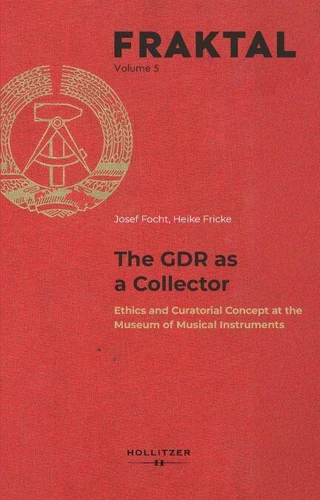
The GDR as a Collector. Ethics and Curatorial Concept at the Museum of Musical Instruments
Par : ,Formats :
Disponible dans votre compte client Decitre ou Furet du Nord dès validation de votre commande. Le format PDF est :
- Compatible avec une lecture sur My Vivlio (smartphone, tablette, ordinateur)
- Compatible avec une lecture sur liseuses Vivlio
- Pour les liseuses autres que Vivlio, vous devez utiliser le logiciel Adobe Digital Edition. Non compatible avec la lecture sur les liseuses Kindle, Remarkable et Sony
 , qui est-ce ?
Notre partenaire de plateforme de lecture numérique où vous retrouverez l'ensemble de vos ebooks gratuitement
Pour en savoir plus sur nos ebooks, consultez notre aide en ligne ici
C'est si simple ! Lisez votre ebook avec l'app Vivlio sur votre tablette, mobile ou ordinateur :

- FormatPDF
- ISBN978-3-99094-641-1
- EAN9783990946411
- Date de parution12/05/2026
- Protection num.Digital Watermarking
- Taille11 Mo
- Infos supplémentairespdf
- ÉditeurHollitzer Wissenschaftsverlag
Résumé
Time and again, the language of collecting and preservation is cloaked in florid rhetoric whenever museums, their purposes and their holdings are evoked - even though the museum world is scarcely bound by legal definition. A closer look at the history and evolution of any institution, not least our own, quickly dispels such illusions. This volume contrasts the bourgeois collecting ideals of prominent nineteenth- and early twentieth-century owners with the Marxist-Leninist notion of collecting as practised in the GDR.
The research centre DIGITAL ORGANOLOGY at the Museum of Musical Instruments, University of Leipzig, brings together an expanding pool of closely interlinked research data across multiple collections.
These data provide a framework for tracing the histories of musical instruments and the collections to which they belong. This infrastructure is designed not only to support detailed, object-based studies, but also to enable large-scale analysis through distant-reading tools. The same applies to provenance research, which, with its legal and ethical obligations, poses major challenges for university museums - in organological scholarship, academic teaching, and the wider transfer of knowledge to society.
These data provide a framework for tracing the histories of musical instruments and the collections to which they belong. This infrastructure is designed not only to support detailed, object-based studies, but also to enable large-scale analysis through distant-reading tools. The same applies to provenance research, which, with its legal and ethical obligations, poses major challenges for university museums - in organological scholarship, academic teaching, and the wider transfer of knowledge to society.
A propos de Josef Focht
29,99 €
29,99 €