Sir Lawrence Freedman is Emeritus Professor of War Studies at King's College London. He was the official historian of the Falklands Campaign, and a member of the official inquiry into Britain and the 2003 Iraq War ('the Chilcot Inquiry'). He has written extensively on nuclear strategy and the Cold War, and comments regularly on contemporary security issues. He is the author of The Future of War, Strategy, (a Financial Times and Economist book of the year) and A Choice of Enemies: America Confronts the Middle East, which won the 2009 Lionel Gelber Prize and Duke of Westminster's Medal for Military Literature.
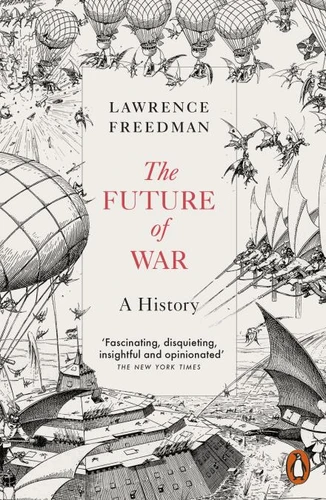
The Future of War. A History
Par :Formats :
Disponible dans votre compte client Decitre ou Furet du Nord dès validation de votre commande. Le format ePub protégé est :
- Compatible avec une lecture sur My Vivlio (smartphone, tablette, ordinateur)
- Compatible avec une lecture sur liseuses Vivlio
- Pour les liseuses autres que Vivlio, vous devez utiliser le logiciel Adobe Digital Edition. Non compatible avec la lecture sur les liseuses Kindle, Remarkable et Sony
- Non compatible avec un achat hors France métropolitaine
 , qui est-ce ?
Notre partenaire de plateforme de lecture numérique où vous retrouverez l'ensemble de vos ebooks gratuitement
Pour en savoir plus sur nos ebooks, consultez notre aide en ligne ici
C'est si simple ! Lisez votre ebook avec l'app Vivlio sur votre tablette, mobile ou ordinateur :

- Nombre de pages352
- FormatePub
- ISBN978-0-14-197561-0
- EAN9780141975610
- Date de parution05/10/2017
- Protection num.Adobe DRM
- Infos supplémentairesepub
- ÉditeurPENGUIN
Résumé
A new approach to ideas about war, from one of the UK's leading strategic thinkersIn 1912 Sir Arthur Conan Doyle wrote a short story about a war fought from underwater submersibles that included the sinking of passenger ships. It was dismissed by the British admirals of the day, not on the basis of technical feasibility, but because sinking civilian ships was not something that any civilised nation would do.
The reality of war often contradicts expectations, less because of some fantastic technical or engineering dimension, but more because of some human, political, or moral threshold that we had never imagined would be crossed. As Lawrence Freedman shows, ideas about the causes of war and strategies for its conduct have rich and varied histories which shape predictions about the future. Freedman shows how looking at how the future of war was conceived about in the past (and why this was more often than not wrong) can put into perspective current thinking about future conflicts.
The Future of War - which takes us from preparations for the world wars, through the nuclear age and the civil wars which became the focus for debate after the end of the Cold War, to present preoccupations with hybrid and cyber warfare - is filled with fascinating insights from one of the most brilliant military and strategic historians of his generation.
The reality of war often contradicts expectations, less because of some fantastic technical or engineering dimension, but more because of some human, political, or moral threshold that we had never imagined would be crossed. As Lawrence Freedman shows, ideas about the causes of war and strategies for its conduct have rich and varied histories which shape predictions about the future. Freedman shows how looking at how the future of war was conceived about in the past (and why this was more often than not wrong) can put into perspective current thinking about future conflicts.
The Future of War - which takes us from preparations for the world wars, through the nuclear age and the civil wars which became the focus for debate after the end of the Cold War, to present preoccupations with hybrid and cyber warfare - is filled with fascinating insights from one of the most brilliant military and strategic historians of his generation.