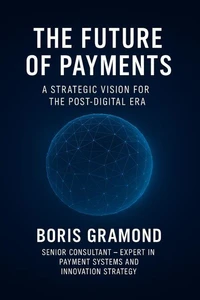
The Future of Payments - A Strategic Vision for the Post-Digital Era(Revised and Expanded Edition 2026)Paying is no longer a discrete act. In the post-digital economy, payment has become an infrastructure layer-largely invisible to the user, yet increasingly powerful as a mechanism of orchestration. It connects platforms, connected objects, digital identities, artificial intelligence, and public systems.
In this forward-looking strategic essay, Boris Gramond delivers a rigorous analysis of the transformations already underway and the plausible trajectories extending from 2026 to 2050 and beyond. The objective is not to predict the future, but to map scenarios: which technological building blocks-ambient payments, financial AI, programmable payments, IoT, identity wallets, brain-computer interfaces, extended reality, and impact-linked currencies-are converging, at what pace, and with what economic, regulatory, and geopolitical consequences.
Structured in three acts, the book explores: 2026-2030: the invisibility and automation of payment, the delegation of financial decisions to AI assistants, and the rise of machine-to-machine transactions. 2030-2040: the cognitive and immersive disruption-wallets merging identity, payment, and citizenship; transactions in extended reality; early brain-computer interfaces. 2040-2050+: extreme yet structured scenarios-autonomous financial AI, the space economy, and post-monetary models based on access, reputation, impact, or time.
At each stage, the book highlights the critical trade-offs shaping the future of payments: infrastructure sovereignty, data governance, security and resilience, risks of surveillance and exclusion, and the fragmentation of standards. Designed for executives, regulators, and innovation leaders, this work provides concrete strategic reference points to decide, invest, regulate, and design payment systems compatible with trust.
The future of payments is not simply about paying faster. It reshapes value, power, and ultimately, freedom of choice.
The Future of Payments - A Strategic Vision for the Post-Digital Era(Revised and Expanded Edition 2026)Paying is no longer a discrete act. In the post-digital economy, payment has become an infrastructure layer-largely invisible to the user, yet increasingly powerful as a mechanism of orchestration. It connects platforms, connected objects, digital identities, artificial intelligence, and public systems.
In this forward-looking strategic essay, Boris Gramond delivers a rigorous analysis of the transformations already underway and the plausible trajectories extending from 2026 to 2050 and beyond. The objective is not to predict the future, but to map scenarios: which technological building blocks-ambient payments, financial AI, programmable payments, IoT, identity wallets, brain-computer interfaces, extended reality, and impact-linked currencies-are converging, at what pace, and with what economic, regulatory, and geopolitical consequences.
Structured in three acts, the book explores: 2026-2030: the invisibility and automation of payment, the delegation of financial decisions to AI assistants, and the rise of machine-to-machine transactions. 2030-2040: the cognitive and immersive disruption-wallets merging identity, payment, and citizenship; transactions in extended reality; early brain-computer interfaces. 2040-2050+: extreme yet structured scenarios-autonomous financial AI, the space economy, and post-monetary models based on access, reputation, impact, or time.
At each stage, the book highlights the critical trade-offs shaping the future of payments: infrastructure sovereignty, data governance, security and resilience, risks of surveillance and exclusion, and the fragmentation of standards. Designed for executives, regulators, and innovation leaders, this work provides concrete strategic reference points to decide, invest, regulate, and design payment systems compatible with trust.
The future of payments is not simply about paying faster. It reshapes value, power, and ultimately, freedom of choice.

 , qui est-ce ?