
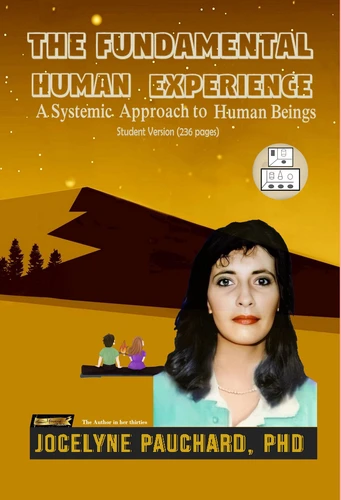
The Fundamental Human Experience. A Systemic Approach to Human Being. Student Version (236 p.)
Par :Formats :
Disponible dans votre compte client Decitre ou Furet du Nord dès validation de votre commande. Le format ePub est :
- Compatible avec une lecture sur My Vivlio (smartphone, tablette, ordinateur)
- Compatible avec une lecture sur liseuses Vivlio
- Pour les liseuses autres que Vivlio, vous devez utiliser le logiciel Adobe Digital Edition. Non compatible avec la lecture sur les liseuses Kindle, Remarkable et Sony
 , qui est-ce ?
Notre partenaire de plateforme de lecture numérique où vous retrouverez l'ensemble de vos ebooks gratuitement
Pour en savoir plus sur nos ebooks, consultez notre aide en ligne ici
C'est si simple ! Lisez votre ebook avec l'app Vivlio sur votre tablette, mobile ou ordinateur :

- FormatePub
- ISBN978-2-9820724-6-6
- EAN9782982072466
- Date de parution18/04/2023
- Protection num.pas de protection
- Infos supplémentairesepub
- ÉditeurÉditions Hinani
Résumé
Written more than twenty years ago, this book is extremely relevant as we still have to deal with the consequences of a situation (C19) and the behaviors and discourses it has generated. What is a vision of man? And how do human visions translate into policies and life choices? The first chapter is devoted to these questions, which lay the foundation for the rest of the book. In Chapters 2 through 4, the author addresses the question, "What is the human being?" Through a series of questions and definitions, the reader is taken through an intellectual process in which he or she is led to appropriate concepts that will equips him or her to express his or her thoughts.
What makes us "human", different from other species? By delineating the physical, psychological and spiritual dimensions, as well as their articulation and their interdependency, the author aims to answer these questions. Chapter 5 is dedicated to Science and to the method of the Scientific Research, a method whose principles have not changed. The author outlines the various procedures and examines the question of research bias, which is a plus for people who want to understand what we mean when we talk about " The " science. Nocebo and placebo effects, researches on the effectiveness of prayer and the quest for the meaning of life are among the topics discussed in this book. The original version was deposited at Library and Archives Canada in September 2001.
Statistics: from a book of 230 pages - 58 724 words; 6725 lines; 1129 paragraphs and 28 jpg. Written more than twenty years ago, this book is extremely relevant as we still have to deal with the consequences of a situation (C19) and the behaviors and discourses it has generated. What is a vision of man? And how do human visions translate into policies and life choices? The first chapter is devoted to these questions, which lay the foundation for the rest of the book.
In Chapters 2 through 4, the author addresses the question, "What is the human being?" Through a series of questions and definitions, the reader is taken through an intellectual process in which he or she is led to appropriate concepts that will equips him or her to express his or her thoughts. What makes us "human", different from other species? By delineating the physical, psychological and spiritual dimensions, as well as their articulation and their interdependency, the author aims to answer these questions.
Chapter 5 is dedicated to Science and to the method of the Scientific Research, a method whose principles have not changed. The author outlines the various procedures and examines the question of research bias, which is a plus for people who want to understand what we mean when we talk about " The " science. Nocebo and placebo effects, researches on the effectiveness of prayer and the quest for the meaning of life are among the topics discussed in this book. The original version was deposited at Library and Archives Canada in September 2001.
Statistics: from a book of 230 pages - 58 724 words; 6725 lines; 1129 paragraphs and 28 jpg.
What makes us "human", different from other species? By delineating the physical, psychological and spiritual dimensions, as well as their articulation and their interdependency, the author aims to answer these questions. Chapter 5 is dedicated to Science and to the method of the Scientific Research, a method whose principles have not changed. The author outlines the various procedures and examines the question of research bias, which is a plus for people who want to understand what we mean when we talk about " The " science. Nocebo and placebo effects, researches on the effectiveness of prayer and the quest for the meaning of life are among the topics discussed in this book. The original version was deposited at Library and Archives Canada in September 2001.
Statistics: from a book of 230 pages - 58 724 words; 6725 lines; 1129 paragraphs and 28 jpg. Written more than twenty years ago, this book is extremely relevant as we still have to deal with the consequences of a situation (C19) and the behaviors and discourses it has generated. What is a vision of man? And how do human visions translate into policies and life choices? The first chapter is devoted to these questions, which lay the foundation for the rest of the book.
In Chapters 2 through 4, the author addresses the question, "What is the human being?" Through a series of questions and definitions, the reader is taken through an intellectual process in which he or she is led to appropriate concepts that will equips him or her to express his or her thoughts. What makes us "human", different from other species? By delineating the physical, psychological and spiritual dimensions, as well as their articulation and their interdependency, the author aims to answer these questions.
Chapter 5 is dedicated to Science and to the method of the Scientific Research, a method whose principles have not changed. The author outlines the various procedures and examines the question of research bias, which is a plus for people who want to understand what we mean when we talk about " The " science. Nocebo and placebo effects, researches on the effectiveness of prayer and the quest for the meaning of life are among the topics discussed in this book. The original version was deposited at Library and Archives Canada in September 2001.
Statistics: from a book of 230 pages - 58 724 words; 6725 lines; 1129 paragraphs and 28 jpg.
A propos de Jocelyne Pauchard, PhD



7,49 €