SOLDES
Jusqu'à -70% sur une sélection d'articles*

Nouveauté
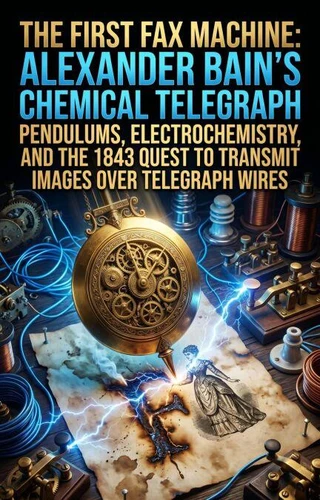
The First Fax Machine: Alexander Bain's Chemical Telegraph. Pendulums, Electrochemistry, and the 1843 Quest to Transmit Images Over Telegraph Wires
Par :Formats :
Disponible dans votre compte client Decitre ou Furet du Nord dès validation de votre commande. Le format ePub est :
- Compatible avec une lecture sur My Vivlio (smartphone, tablette, ordinateur)
- Compatible avec une lecture sur liseuses Vivlio
- Pour les liseuses autres que Vivlio, vous devez utiliser le logiciel Adobe Digital Edition. Non compatible avec la lecture sur les liseuses Kindle, Remarkable et Sony
 , qui est-ce ?
Notre partenaire de plateforme de lecture numérique où vous retrouverez l'ensemble de vos ebooks gratuitement
Pour en savoir plus sur nos ebooks, consultez notre aide en ligne ici
C'est si simple ! Lisez votre ebook avec l'app Vivlio sur votre tablette, mobile ou ordinateur :

- Nombre de pages150
- FormatePub
- ISBN978-3-565-46104-2
- EAN9783565461042
- Date de parution26/05/2026
- Protection num.pas de protection
- Taille846 Ko
- Infos supplémentairesepub
- ÉditeurEmphaloz Publishing House
Résumé
Three decades before Alexander Graham Bell patented the telephone, and over a century before the modern office fax machine beeped into existence, a Scottish clockmaker named Alexander Bain was already transmitting rudimentary images over electrical wires. His 1843 patent for the "Chemical Telegraph" is one of the most astonishing, premature technological breakthroughs of the Victorian era.
Bain's invention relied on perfect mechanical synchronization.
He used two heavy clock pendulums, one at the sending station and one at the receiving end, swinging in exact unison. At the receiving end, an electrical stylus swept across a piece of paper soaked in ammonium nitrate and potassium ferrocyanide. When an electrical pulse was transmitted, it triggered a chemical reaction, leaving a blue mark on the paper. By scanning line by line, Bain could successfully reproduce crude drawings and handwriting miles away. This deep dive into early telecommunications explores the genius of analog engineering.
It documents the intense rivalry between Bain and Samuel Morse, the struggle to maintain perfect pendulum synchronization over long distances, and the electrochemistry that allowed engineers to literally "burn" images into paper using electricity. The fax machine is older than the phone. The First Fax Machine reclaims the legacy of the brilliant clockmaker who realized that images, not just clicks, could be sent across a wire.
He used two heavy clock pendulums, one at the sending station and one at the receiving end, swinging in exact unison. At the receiving end, an electrical stylus swept across a piece of paper soaked in ammonium nitrate and potassium ferrocyanide. When an electrical pulse was transmitted, it triggered a chemical reaction, leaving a blue mark on the paper. By scanning line by line, Bain could successfully reproduce crude drawings and handwriting miles away. This deep dive into early telecommunications explores the genius of analog engineering.
It documents the intense rivalry between Bain and Samuel Morse, the struggle to maintain perfect pendulum synchronization over long distances, and the electrochemistry that allowed engineers to literally "burn" images into paper using electricity. The fax machine is older than the phone. The First Fax Machine reclaims the legacy of the brilliant clockmaker who realized that images, not just clicks, could be sent across a wire.