SOLDES
Jusqu'à -70% sur une sélection d'articles*

Nouveauté
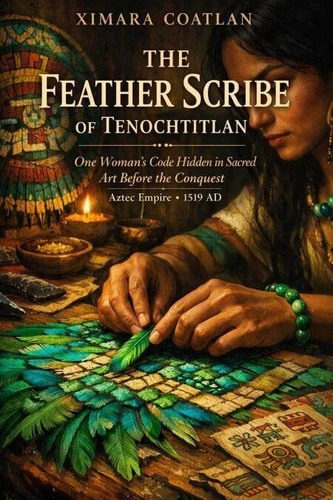
THE FEATHER SCRIBE OF TENOCHTITLAN: One Woman's Code Hidden in Sacred Art Before the Conquest
Par :Formats :
Disponible dans votre compte client Decitre ou Furet du Nord dès validation de votre commande. Le format ePub est :
- Compatible avec une lecture sur My Vivlio (smartphone, tablette, ordinateur)
- Compatible avec une lecture sur liseuses Vivlio
- Pour les liseuses autres que Vivlio, vous devez utiliser le logiciel Adobe Digital Edition. Non compatible avec la lecture sur les liseuses Kindle, Remarkable et Sony
 , qui est-ce ?
Notre partenaire de plateforme de lecture numérique où vous retrouverez l'ensemble de vos ebooks gratuitement
Pour en savoir plus sur nos ebooks, consultez notre aide en ligne ici
C'est si simple ! Lisez votre ebook avec l'app Vivlio sur votre tablette, mobile ou ordinateur :

- FormatePub
- ISBN8235098268
- EAN9798235098268
- Date de parution01/06/2026
- Protection num.pas de protection
- Infos supplémentairesepub
- ÉditeurIoakim Ioakim
Résumé
Tenochtitlan, 1519. A young featherworker named Iztac sorts quetzal feathers in her father's workshop in the Amantlan barrio while the most powerful city in the world holds its breath. The strangers have appeared on the eastern shore. The emperor's gifts have been sent. And no one in the palace can agree on what the floating houses and the thunder weapons and the hard-bodied men on four-legged animals actually mean.
Iztac knows what they mean. She has been building a picture from the coastal intelligence arriving through the pochteca merchant network, from the shift in palace commission requests toward protective iconography, from the specific calendar position of the year One Reed and what the divinatory tradition associates with it. What she knows, she cannot say aloud. But she can encode it. Iztac possesses a double literacy that no one else in the Mexica world shares: she has been secretly trained as both a tlacuilo, a codex scribe, and as an amanteca master, a featherworker who understands the full symbolic grammar of colors, birds, and calendar signs embedded in the sacred art.
In the specific space between these two traditions, she develops an encoding system: feather counts at precise positions in the design, corresponding to calendar day-signs, building messages that look like conventional ceremonial art to every observer without the key. Over the months of 1519 and 1520, she produces twenty-three encoded pieces: fan handles, shield mosaics, headdress panels, warrior backracks.
Each carries a section of the complete intelligence picture she has assembled about the strangers' numbers, weapons, alliances, and intentions. The pieces travel through Cuauhtemoc's military network, through her friend Chimal's pochteca family, and through one extraordinary conversation with the woman history calls La Malinche, who takes the key piece and vanishes into the Spanish expedition. Some of those twenty-three pieces are almost certainly in European museum collections right now, identified as decorative objects of historical interest.
The encoded content has never been looked for. The Feather Scribe of Tenochtitlan is a novel about the specific intelligence of a civilization that was dismissed as primitive, about what it costs to know something you cannot make the people in power understand, and about the specific kind of courage involved in creating a record of your world's destruction in the language your world invented to describe its beauty.
It is also, quietly and precisely, an invitation to scholars of Mexica featherwork to look at the surviving pieces with a question they have not yet asked. The feathers are still there. The grammar is still in them. The message does not require understanding in the present. It requires survival.
Iztac knows what they mean. She has been building a picture from the coastal intelligence arriving through the pochteca merchant network, from the shift in palace commission requests toward protective iconography, from the specific calendar position of the year One Reed and what the divinatory tradition associates with it. What she knows, she cannot say aloud. But she can encode it. Iztac possesses a double literacy that no one else in the Mexica world shares: she has been secretly trained as both a tlacuilo, a codex scribe, and as an amanteca master, a featherworker who understands the full symbolic grammar of colors, birds, and calendar signs embedded in the sacred art.
In the specific space between these two traditions, she develops an encoding system: feather counts at precise positions in the design, corresponding to calendar day-signs, building messages that look like conventional ceremonial art to every observer without the key. Over the months of 1519 and 1520, she produces twenty-three encoded pieces: fan handles, shield mosaics, headdress panels, warrior backracks.
Each carries a section of the complete intelligence picture she has assembled about the strangers' numbers, weapons, alliances, and intentions. The pieces travel through Cuauhtemoc's military network, through her friend Chimal's pochteca family, and through one extraordinary conversation with the woman history calls La Malinche, who takes the key piece and vanishes into the Spanish expedition. Some of those twenty-three pieces are almost certainly in European museum collections right now, identified as decorative objects of historical interest.
The encoded content has never been looked for. The Feather Scribe of Tenochtitlan is a novel about the specific intelligence of a civilization that was dismissed as primitive, about what it costs to know something you cannot make the people in power understand, and about the specific kind of courage involved in creating a record of your world's destruction in the language your world invented to describe its beauty.
It is also, quietly and precisely, an invitation to scholars of Mexica featherwork to look at the surviving pieces with a question they have not yet asked. The feathers are still there. The grammar is still in them. The message does not require understanding in the present. It requires survival.