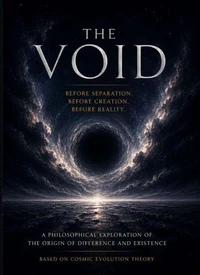
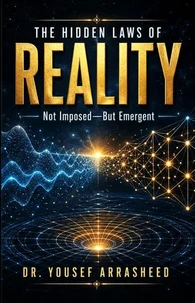
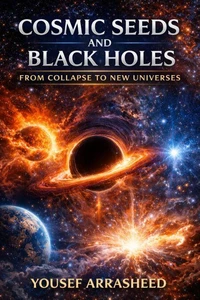
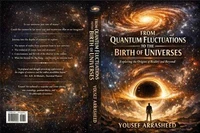
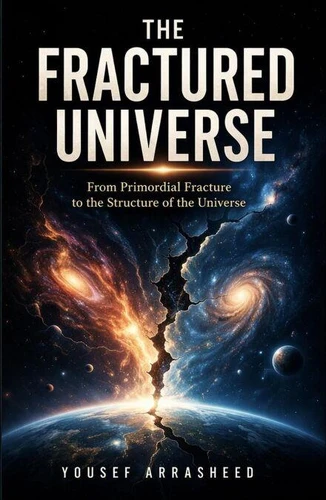
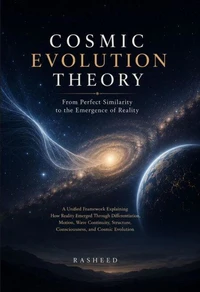
What if the universe is not built from matter and energy-but from something deeper?In Cosmic Seeds and Black Holes, Yousef Arrasheed presents a bold and unified vision of reality, where the universe is not a collection of separate forces and particles, but a single evolving system shaped by structural imbalance. At the core of this work lies a powerful idea: the universe began not with matter, but with a transformation-a structural phase transition referred to as the fracture.
This transition activated latent laws and gave rise to everything we observe today. From this perspective: Matter emerges as localized stability within an unstable system Gravity is not a fundamental force, but a flow driven by structural gradients Dark matter is not an unknown particle, but hidden structural concentration Dark energy is not a mysterious force, but the large-scale response of the system to imbalance Blending physics and philosophy, this book introduces the Rasheed Model, a conceptual and semi-mathematical framework that unifies gravity, matter, dark matter, and cosmic expansion under a single principle.
Rather than replacing modern physics, this work reinterprets it-offering a new way to understand the origin, structure, and evolution of the universe. This is not just a theory about the cosmos. It is an attempt to rethink the foundation of reality itself. If the universe is not a static creation, but a continuous process, then every end may be the beginning of something new.
What if the universe is not built from matter and energy-but from something deeper?In Cosmic Seeds and Black Holes, Yousef Arrasheed presents a bold and unified vision of reality, where the universe is not a collection of separate forces and particles, but a single evolving system shaped by structural imbalance. At the core of this work lies a powerful idea: the universe began not with matter, but with a transformation-a structural phase transition referred to as the fracture.
This transition activated latent laws and gave rise to everything we observe today. From this perspective: Matter emerges as localized stability within an unstable system Gravity is not a fundamental force, but a flow driven by structural gradients Dark matter is not an unknown particle, but hidden structural concentration Dark energy is not a mysterious force, but the large-scale response of the system to imbalance Blending physics and philosophy, this book introduces the Rasheed Model, a conceptual and semi-mathematical framework that unifies gravity, matter, dark matter, and cosmic expansion under a single principle.
Rather than replacing modern physics, this work reinterprets it-offering a new way to understand the origin, structure, and evolution of the universe. This is not just a theory about the cosmos. It is an attempt to rethink the foundation of reality itself. If the universe is not a static creation, but a continuous process, then every end may be the beginning of something new.

 , qui est-ce ?