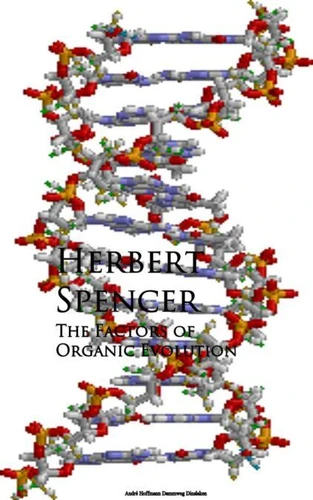
The Factors of Organic Evolution
Par :Formats :
Disponible dans votre compte client Decitre ou Furet du Nord dès validation de votre commande. Le format ePub est :
- Compatible avec une lecture sur My Vivlio (smartphone, tablette, ordinateur)
- Compatible avec une lecture sur liseuses Vivlio
- Pour les liseuses autres que Vivlio, vous devez utiliser le logiciel Adobe Digital Edition. Non compatible avec la lecture sur les liseuses Kindle, Remarkable et Sony
 , qui est-ce ?
Notre partenaire de plateforme de lecture numérique où vous retrouverez l'ensemble de vos ebooks gratuitement
Pour en savoir plus sur nos ebooks, consultez notre aide en ligne ici
C'est si simple ! Lisez votre ebook avec l'app Vivlio sur votre tablette, mobile ou ordinateur :

- Nombre de pages168
- FormatePub
- ISBN978-3-7364-1672-7
- EAN9783736416727
- Date de parution26/09/2016
- Protection num.Digital Watermarking
- Taille198 Ko
- Infos supplémentairesepub
- ÉditeurAndhof
Résumé
The two parts of which this Essay consists, originally published in The Nineteenth Century for April and May 1886 respectively, now reappear with the assent of the proprietor and editor of that periodical, to whom my thanks are due for his courtesy in giving it. Some passages of considerable length which, with a view to needful brevity, were omitted when the articles first appeared, have been restored.
Though the direct bearings of the arguments contained in this Essay are biological, the argument contained in its first half has indirect bearings upon Psychology, Ethics, and Sociology.
My belief in the profound importance of these indirect bearings, was originally a chief prompter to set forth the argument; and it now prompts me to re-issue it in permanent form. Though mental phenomena of many kinds, and especially of the simpler kinds, are explicable only as resulting from the natural selection of favourable variations; yet there are, I believe, still more numerous mental phenomena, including all those of any considerable complexity, which cannot be explained otherwise than as results of the inheritance of functionally-produced modifications.
What theory of psychological evolution is espoused, thus depends vion acceptance or rejection of the doctrine that not only in the individual, but in the successions of individuals, use and disuse of parts produce respectively increase and decrease of them. Of course there are involved the conceptions we form of the genesis and nature of our higher emotions; and, by implication, the conceptions we form of our moral intuitions.
If functionally-produced modifications are inheritable, then the mental associations habitually produced in individuals by experiences of the relations between actions and their consequences, pleasurable or painful, may, in the successions of individuals, generate innate tendencies to like or dislike such actions.
My belief in the profound importance of these indirect bearings, was originally a chief prompter to set forth the argument; and it now prompts me to re-issue it in permanent form. Though mental phenomena of many kinds, and especially of the simpler kinds, are explicable only as resulting from the natural selection of favourable variations; yet there are, I believe, still more numerous mental phenomena, including all those of any considerable complexity, which cannot be explained otherwise than as results of the inheritance of functionally-produced modifications.
What theory of psychological evolution is espoused, thus depends vion acceptance or rejection of the doctrine that not only in the individual, but in the successions of individuals, use and disuse of parts produce respectively increase and decrease of them. Of course there are involved the conceptions we form of the genesis and nature of our higher emotions; and, by implication, the conceptions we form of our moral intuitions.
If functionally-produced modifications are inheritable, then the mental associations habitually produced in individuals by experiences of the relations between actions and their consequences, pleasurable or painful, may, in the successions of individuals, generate innate tendencies to like or dislike such actions.