
Nouveauté
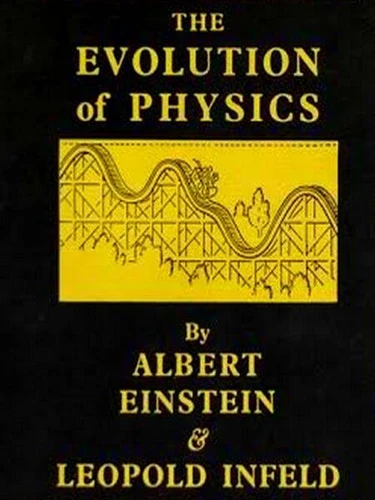
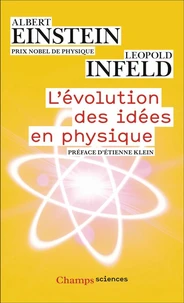
The Evolution of Physics
Par : ,Formats :
Disponible dans votre compte client Decitre ou Furet du Nord dès validation de votre commande. Le format ePub est :
- Compatible avec une lecture sur My Vivlio (smartphone, tablette, ordinateur)
- Compatible avec une lecture sur liseuses Vivlio
- Pour les liseuses autres que Vivlio, vous devez utiliser le logiciel Adobe Digital Edition. Non compatible avec la lecture sur les liseuses Kindle, Remarkable et Sony
 , qui est-ce ?
Notre partenaire de plateforme de lecture numérique où vous retrouverez l'ensemble de vos ebooks gratuitement
Pour en savoir plus sur nos ebooks, consultez notre aide en ligne ici
C'est si simple ! Lisez votre ebook avec l'app Vivlio sur votre tablette, mobile ou ordinateur :

- FormatePub
- ISBN8902439066
- EAN9798902439066
- Date de parution07/07/2026
- Protection num.Digital Watermarking
- Taille481 Ko
- Infos supplémentairesepub
- ÉditeurRare Treasure Editions
Résumé
"The Evolution of Physics: The Growth of Ideas from Early Concepts to Relativity and Quanta" is a classic science book written for the layperson by Albert Einstein and Leopold Infeld. It traces the progression of physics concepts, exploring the transition from early mechanical models to relativity and quantum mechanics. As a history and survey of the development of ideas in physics, it was a popular success and was featured in a Time magazine cover story.
The book begins with classical mechanics, detailing how Isaac Newton's early concepts treated forces and particles. It introduces the shift toward understanding continuous physical fields, such as electricity and magnetism. Einstein uses this accessible medium to explain his theories of relativity, arguing that space and time are interconnected. The authors advocate for a realist approach to physics, exploring how observations interact with our belief in an objective, independent physical reality.
The book begins with classical mechanics, detailing how Isaac Newton's early concepts treated forces and particles. It introduces the shift toward understanding continuous physical fields, such as electricity and magnetism. Einstein uses this accessible medium to explain his theories of relativity, arguing that space and time are interconnected. The authors advocate for a realist approach to physics, exploring how observations interact with our belief in an objective, independent physical reality.
A propos de Albert Einstein
6,30 €
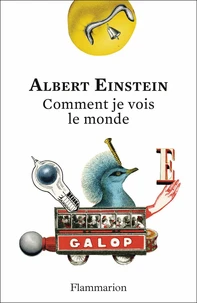
Comment je vois le monde
Edition collector
Edition collector
Grand Format
14,90 €
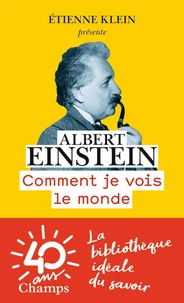
Comment je vois le monde
Grand Format
8,00 €

Pourquoi la guerre ?
Poche
4,90 €
13,55 €

8,50 €

9,70 €
4,90 €

4,22 €