
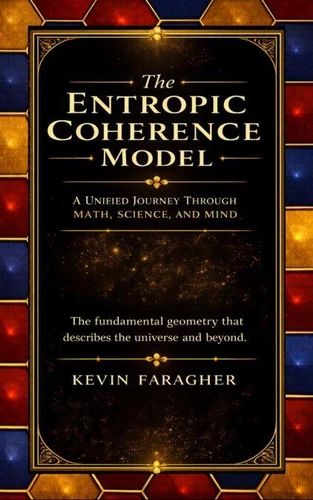
The Entropic Coherence Model
Par :Formats :
Disponible dans votre compte client Decitre ou Furet du Nord dès validation de votre commande. Le format ePub est :
- Compatible avec une lecture sur My Vivlio (smartphone, tablette, ordinateur)
- Compatible avec une lecture sur liseuses Vivlio
- Pour les liseuses autres que Vivlio, vous devez utiliser le logiciel Adobe Digital Edition. Non compatible avec la lecture sur les liseuses Kindle, Remarkable et Sony
 , qui est-ce ?
Notre partenaire de plateforme de lecture numérique où vous retrouverez l'ensemble de vos ebooks gratuitement
Pour en savoir plus sur nos ebooks, consultez notre aide en ligne ici
C'est si simple ! Lisez votre ebook avec l'app Vivlio sur votre tablette, mobile ou ordinateur :

- FormatePub
- ISBN8218939694
- EAN9798218939694
- Date de parution04/03/2026
- Protection num.pas de protection
- Infos supplémentairesepub
- ÉditeurIndependently Published
Résumé
The Entropic Coherence Model, ECM, is a geometry first framework that aims to build one internally consistent substrate across math, physics, and mind. It treats structure as something you can track, test, and scale. It is a framework that unifies consciousness, astrophysics, and particle physics under a conservation first geometric system that lets readers visualize Lie algebra at every scale. We introduce the geometry of scalar units, dimensional units, prefractal units, and fractal units, showing how symmetry stacks into higher structure.
Perfect numbers and Mersenne primes act as dimensional mapping checkpoints, and vortex math turns closure cycles into conservation gradients. If you've ever wanted a visual language for the hardest problems in math and science, this is it. This book is written to be read at multiple depths. You can follow the intuitive thread, or you can keep drilling into the formal structure, definitions, and technical logic as far as you want.
The goal is to be consistent, explicit, and usable as a shared substrate for other work. What you'll find inside A geometry first language for thinking about structure, symmetry, and conservation Visual intuition for Lie algebra and how symmetry stacks into higher order systems Perfect numbers, Mersenne primes, and dimensional checkpoints used as a mapping scaffold Vortex style closure cycles translated into conservation gradients A layered reading path that progresses from math and geometry to harmonics, particle physics, consciousness, and astrophysics Who this is for Technical readers who want a mathematical and conservation first theory of everything, and anyone chasing unification across physics, cosmology, information, and mind.
Casual readers who want a big picture, geometry first lens on reality that can carry those visuals into other domains to understand them more clearly. If you care about unification, coherent definitions, and models that can be argued with directly, ECM is built for that style of thinking.
Perfect numbers and Mersenne primes act as dimensional mapping checkpoints, and vortex math turns closure cycles into conservation gradients. If you've ever wanted a visual language for the hardest problems in math and science, this is it. This book is written to be read at multiple depths. You can follow the intuitive thread, or you can keep drilling into the formal structure, definitions, and technical logic as far as you want.
The goal is to be consistent, explicit, and usable as a shared substrate for other work. What you'll find inside A geometry first language for thinking about structure, symmetry, and conservation Visual intuition for Lie algebra and how symmetry stacks into higher order systems Perfect numbers, Mersenne primes, and dimensional checkpoints used as a mapping scaffold Vortex style closure cycles translated into conservation gradients A layered reading path that progresses from math and geometry to harmonics, particle physics, consciousness, and astrophysics Who this is for Technical readers who want a mathematical and conservation first theory of everything, and anyone chasing unification across physics, cosmology, information, and mind.
Casual readers who want a big picture, geometry first lens on reality that can carry those visuals into other domains to understand them more clearly. If you care about unification, coherent definitions, and models that can be argued with directly, ECM is built for that style of thinking.