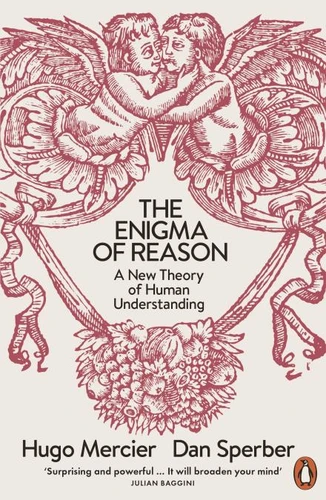
The Enigma of Reason. A New Theory of Human Understanding
Par : ,Formats :
Disponible dans votre compte client Decitre ou Furet du Nord dès validation de votre commande. Le format ePub protégé est :
- Compatible avec une lecture sur My Vivlio (smartphone, tablette, ordinateur)
- Compatible avec une lecture sur liseuses Vivlio
- Pour les liseuses autres que Vivlio, vous devez utiliser le logiciel Adobe Digital Edition. Non compatible avec la lecture sur les liseuses Kindle, Remarkable et Sony
- Non compatible avec un achat hors France métropolitaine
 , qui est-ce ?
Notre partenaire de plateforme de lecture numérique où vous retrouverez l'ensemble de vos ebooks gratuitement
Pour en savoir plus sur nos ebooks, consultez notre aide en ligne ici
C'est si simple ! Lisez votre ebook avec l'app Vivlio sur votre tablette, mobile ou ordinateur :

- Nombre de pages224
- FormatePub
- ISBN978-1-84614-558-2
- EAN9781846145582
- Date de parution06/04/2017
- Protection num.Adobe DRM
- Infos supplémentairesepub
- ÉditeurPenguin
Résumé
GUARDIAN BOOKS OF THE YEAR 2017'Original and provocative ... likely to have a big impact on our understanding of ourselves' Steven Pinker'Mercier and Sperber offer a surprising and powerful response to the new orthodoxy propounded by Kahneman and Tversky ... arguing that the supposed flaws of hot, fast, automatic thinking are actually design features which work remarkably well' Julian BagginiReason, we are told, is what makes us human, the source of our knowledge and wisdom.
But, if reason is so useful, why didn't it also evolve in other animals? If it is that reliable, why do we produce so much thoroughly reasoned nonsense?In their ground-breaking account of the evolution and workings of reason, Hugo Mercier and Dan Sperber set out to solve this double enigma, taking us on a journey from desert ants to modern scientists, and from Aristotle to Daniel Kahneman. Reason, they argue with a compelling mix of real-life and experimental evidence, is not geared to solitary use, to arriving at better beliefs and decisions on our own.
What reason does, rather, is help us justify our beliefs and actions to others, convince them through argumentation, and evaluate the justifications and arguments that they address to us. In other words, reason has evolved to help humans better exploit their uniquely rich social environment. This illuminating interpretation of reason makes sense of strengths and weaknesses that have long puzzled philosophers and psychologists - why reason is biased in favour of what we already believe, why it may lead to terrible ideas and yet is indispensable to spreading good ones.
Ambitious, provocative, and entertaining, The Enigma of Reason will spark debate among psychologists and philosophers, and make many reasonable people rethink their own thinking.
But, if reason is so useful, why didn't it also evolve in other animals? If it is that reliable, why do we produce so much thoroughly reasoned nonsense?In their ground-breaking account of the evolution and workings of reason, Hugo Mercier and Dan Sperber set out to solve this double enigma, taking us on a journey from desert ants to modern scientists, and from Aristotle to Daniel Kahneman. Reason, they argue with a compelling mix of real-life and experimental evidence, is not geared to solitary use, to arriving at better beliefs and decisions on our own.
What reason does, rather, is help us justify our beliefs and actions to others, convince them through argumentation, and evaluate the justifications and arguments that they address to us. In other words, reason has evolved to help humans better exploit their uniquely rich social environment. This illuminating interpretation of reason makes sense of strengths and weaknesses that have long puzzled philosophers and psychologists - why reason is biased in favour of what we already believe, why it may lead to terrible ideas and yet is indispensable to spreading good ones.
Ambitious, provocative, and entertaining, The Enigma of Reason will spark debate among psychologists and philosophers, and make many reasonable people rethink their own thinking.