
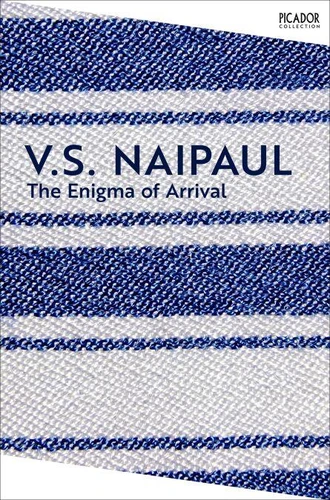
The Enigma of Arrival. A Novel in Five Sections
Par :Formats :
Disponible dans votre compte client Decitre ou Furet du Nord dès validation de votre commande. Le format ePub protégé est :
- Compatible avec une lecture sur My Vivlio (smartphone, tablette, ordinateur)
- Compatible avec une lecture sur liseuses Vivlio
- Pour les liseuses autres que Vivlio, vous devez utiliser le logiciel Adobe Digital Edition. Non compatible avec la lecture sur les liseuses Kindle, Remarkable et Sony
- Non compatible avec un achat hors France métropolitaine
 , qui est-ce ?
Notre partenaire de plateforme de lecture numérique où vous retrouverez l'ensemble de vos ebooks gratuitement
Pour en savoir plus sur nos ebooks, consultez notre aide en ligne ici
C'est si simple ! Lisez votre ebook avec l'app Vivlio sur votre tablette, mobile ou ordinateur :

- Nombre de pages400
- FormatePub
- ISBN978-0-330-51631-0
- EAN9780330516310
- Date de parution22/03/2012
- Protection num.Adobe DRM
- Infos supplémentairesepub
- ÉditeurPicador
Résumé
A beautifully rendered work of autofiction from the winner of the Nobel Prize in Literature. Taking its title from the strangely frozen picture by the surrealist painter Giorgio de Chirico, The Enigma of Arrival tells the story of a young Indian from the Caribbean arriving in post-imperial England and consciously, over many years, finding himself as a writer. It is the story of a journey, from one place to another, from the British colony of Trinidad to the ancient countryside of England, and from one state of mind to another, and is perhaps V.
S. Naipaul's most autobiographical work. Yet alongside this he weaves a rich and complex web of invention and observation. Finding depth and pathos in the smallest moments - the death of a cottager, the firing of an estate's gardener - Naipaul also comprehends the bigger picture - watching as the old world is lost to the gradual but permanent changes wrought on the English landscape by the march of 'progress'.'Written with the expected beauty of style .
S. Naipaul's most autobiographical work. Yet alongside this he weaves a rich and complex web of invention and observation. Finding depth and pathos in the smallest moments - the death of a cottager, the firing of an estate's gardener - Naipaul also comprehends the bigger picture - watching as the old world is lost to the gradual but permanent changes wrought on the English landscape by the march of 'progress'.'Written with the expected beauty of style .
A propos de V.S. Naipaul

In a Free State
E-book
11,99 €
India: Essays
E-book
10,99 €


The Indian Trilogy
E-book
22,99 €

12,99 €

Magic Seeds
E-book
12,99 €
11,99 €
14,99 €

12,99 €

14,99 €

The Mystic Masseur
E-book
14,99 €

A Turn in the South
E-book
13,99 €
Half a Life
E-book
11,99 €
10,99 €

14,99 €


The Mimic Men
E-book
11,99 €