SOLDES
Jusqu'à -70% sur une sélection d'articles*

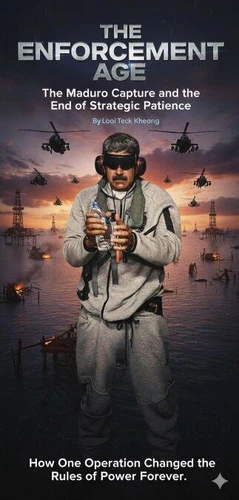
The Enforcement Age - The Maduro Capture and the End of Strategic Patience. Political Security - International Relations, #1
Par :Formats :
Disponible dans votre compte client Decitre ou Furet du Nord dès validation de votre commande. Le format ePub est :
- Compatible avec une lecture sur My Vivlio (smartphone, tablette, ordinateur)
- Compatible avec une lecture sur liseuses Vivlio
- Pour les liseuses autres que Vivlio, vous devez utiliser le logiciel Adobe Digital Edition. Non compatible avec la lecture sur les liseuses Kindle, Remarkable et Sony
 , qui est-ce ?
Notre partenaire de plateforme de lecture numérique où vous retrouverez l'ensemble de vos ebooks gratuitement
Pour en savoir plus sur nos ebooks, consultez notre aide en ligne ici
C'est si simple ! Lisez votre ebook avec l'app Vivlio sur votre tablette, mobile ou ordinateur :

- FormatePub
- ISBN8233306013
- EAN9798233306013
- Date de parution30/01/2026
- Protection num.pas de protection
- Infos supplémentairesepub
- ÉditeurLinda Balsamo
Résumé
At 04:17 a.m. on January 3, 2026, the international system crossed a threshold it had long resisted. The capture of a sitting head of state-executed not as war, not as regime change, but as enforcement-signalled a structural shift in how power, law, and sovereignty now operate. The Enforcement Age: The Maduro Capture and the End of Strategic Patience is the first full-length strategic analysis of that moment and of what it reveals about the future of international relations.
This book examines the capture of Nicolás Maduro not as an isolated geopolitical shock, but as a systemic event exposing the limits of long-standing assumptions: sovereignty as an absolute shield, sanctions as a sufficient response, and strategic patience as a substitute for consequence. It argues that when indirect tools fail, when transnational harm becomes persistent and measurable, and when leadership becomes inseparable from criminalised governance, enforcement re-enters international affairs as a structural response rather than an exception.
Written in the immediate aftermath of the operation, the book prioritises framework over hindsight and implication over attribution. It is not investigative journalism, nor a judicial finding, nor an official historical record. It draws on publicly available information, professional legal and policy expertise, and informed strategic assessment to illuminate how enforcement logic now operates under conditions of extreme geopolitical stress.
To make complex institutional dynamics intelligible, the book employs analytical reconstruction and illustrative narrative techniques. Certain scenes, dialogue, internal deliberations, operational descriptions, and perspectives are intentionally composite or fictionalised. These reconstructions are not presented as documented fact, but as explanatory devices designed to clarify decision-making where records remain contested, classified, or unavailable.
This method allows readers to understand how law, intelligence, diplomacy, and power interact when events move faster than institutions. Central to the analysis is a question that will shape the coming decade: what happens when enforcement replaces persuasion as the organising principle of international order? The book explores the legal tensions this creates, the precedents it sets, and the strategic recalibrations it forces-from Washington and Beijing to Moscow, ASEAN, MERCOSUR, and beyond.
It examines how leadership capture alters calculations for states operating in legal grey zones, and why criminalised sovereignty accelerates exposure rather than protection. This work also includes a transparent acknowledgement of responsible AI use. Generative AI tools were employed in a limited and disclosed manner to support language refinement and structural clarity. The arguments, analytical framework, narrative architecture, legal reasoning, and strategic conclusions are the author's own, reflecting his professional judgment, experience, and original intellectual contribution.
AI tools did not determine the thesis, the structure of the book, or the substantive positions advanced. The Enforcement Age is written for policymakers, diplomats, legal practitioners, scholars, security professionals, and informed readers seeking to understand why familiar assumptions about restraint and immunity no longer hold. It does not celebrate power, nor advocate routine intervention. It identifies a threshold that has been crossed and maps the consequences of that crossing.
This book is best read not as a verdict, but as an orientation: a first map drawn after the ground has shifted, explaining how international law and international relations are being rewritten by action rather than theory-and why the enforcement age has begun.
This book examines the capture of Nicolás Maduro not as an isolated geopolitical shock, but as a systemic event exposing the limits of long-standing assumptions: sovereignty as an absolute shield, sanctions as a sufficient response, and strategic patience as a substitute for consequence. It argues that when indirect tools fail, when transnational harm becomes persistent and measurable, and when leadership becomes inseparable from criminalised governance, enforcement re-enters international affairs as a structural response rather than an exception.
Written in the immediate aftermath of the operation, the book prioritises framework over hindsight and implication over attribution. It is not investigative journalism, nor a judicial finding, nor an official historical record. It draws on publicly available information, professional legal and policy expertise, and informed strategic assessment to illuminate how enforcement logic now operates under conditions of extreme geopolitical stress.
To make complex institutional dynamics intelligible, the book employs analytical reconstruction and illustrative narrative techniques. Certain scenes, dialogue, internal deliberations, operational descriptions, and perspectives are intentionally composite or fictionalised. These reconstructions are not presented as documented fact, but as explanatory devices designed to clarify decision-making where records remain contested, classified, or unavailable.
This method allows readers to understand how law, intelligence, diplomacy, and power interact when events move faster than institutions. Central to the analysis is a question that will shape the coming decade: what happens when enforcement replaces persuasion as the organising principle of international order? The book explores the legal tensions this creates, the precedents it sets, and the strategic recalibrations it forces-from Washington and Beijing to Moscow, ASEAN, MERCOSUR, and beyond.
It examines how leadership capture alters calculations for states operating in legal grey zones, and why criminalised sovereignty accelerates exposure rather than protection. This work also includes a transparent acknowledgement of responsible AI use. Generative AI tools were employed in a limited and disclosed manner to support language refinement and structural clarity. The arguments, analytical framework, narrative architecture, legal reasoning, and strategic conclusions are the author's own, reflecting his professional judgment, experience, and original intellectual contribution.
AI tools did not determine the thesis, the structure of the book, or the substantive positions advanced. The Enforcement Age is written for policymakers, diplomats, legal practitioners, scholars, security professionals, and informed readers seeking to understand why familiar assumptions about restraint and immunity no longer hold. It does not celebrate power, nor advocate routine intervention. It identifies a threshold that has been crossed and maps the consequences of that crossing.
This book is best read not as a verdict, but as an orientation: a first map drawn after the ground has shifted, explaining how international law and international relations are being rewritten by action rather than theory-and why the enforcement age has begun.